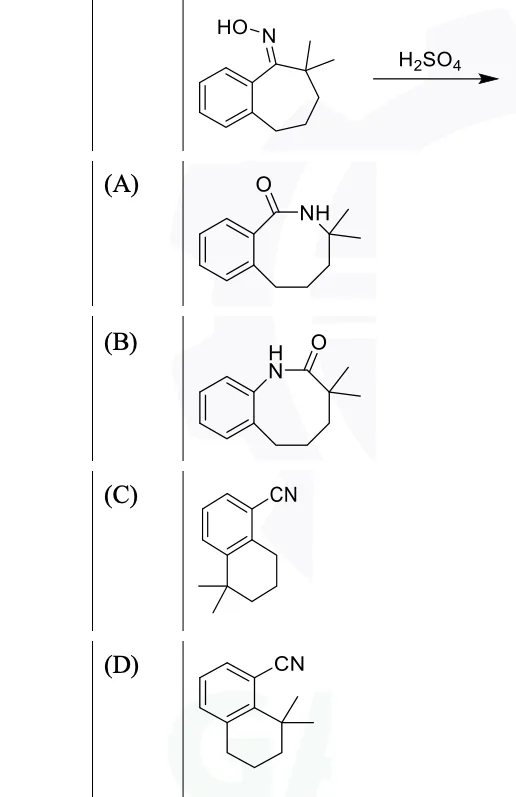
The major product formed in the following reaction is
AStructure (A)
BStructure (B)
CStructure (C)
DStructure (D)
Show answer and explanation
Answer: C. Structure (C)
Because the oxime possesses a quaternary carbon anti to the leaving group, it undergoes a Beckmann fragmentation (abnormal Beckmann) instead of a regular Beckmann rearrangement (ruling out lactams A and B). Cleavage of the C−C bond yields a benzonitrile bearing a tethered tertiary carbocation, Ar−CHX2CHX2CHX2−CX+(Me)X2. Intramolecular electrophilic aromatic substitution (Friedel-Crafts alkylation) of this carbocation onto the adjacent open aromatic position forms a six-membered tetralin ring with the −C(Me)X2X− group meta to the −CN, giving structure (C) rather than (D).
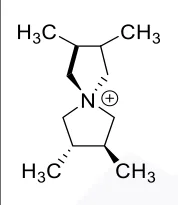
The correct statement about the following quaternary ammonium ion is
AIt has only C2-symmetry, hence chiral
BIt has S4-symmetry, hence achiral
CIt has no symmetry, hence chiral
DIt has a centre of symmetry, hence achiral
Show answer and explanation
Answer: B. It has S4-symmetry, hence achiral
The spiro nitrogen atom holds the two pyrrolidine rings in mutually perpendicular planes. A 90∘ rotation about the central vertical axis followed by reflection through a horizontal plane through the nitrogen atom brings the molecule into coincidence with itself, demonstrating an improper axis of rotation (S4). Molecules possessing an alternating axis of symmetry are achiral even in the absence of a mirror plane or inversion centre, so Option A and Option D are incorrect.
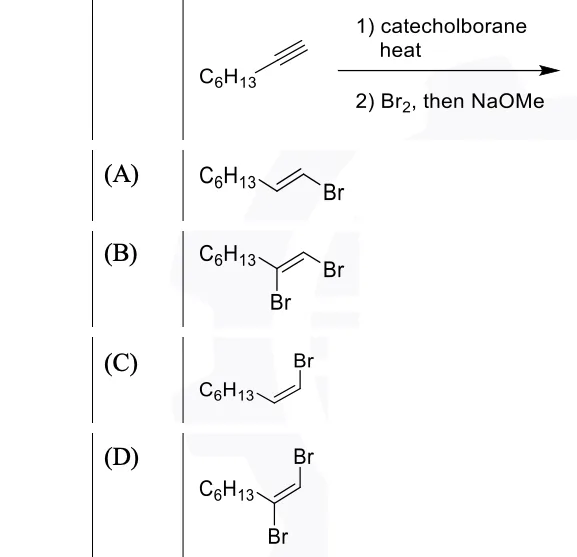
The major product formed in the following reaction sequence is
CX6HX13−C≡CH1) catecholborane, heat2) Br2, then NaOMe
AStructure (A)
BStructure (B)
CStructure (C)
DStructure (D)
Show answer and explanation
Answer: C. Structure (C)
Hydroboration of the terminal alkyne with catecholborane yields an (E)-alkenylboronate via syn-addition. Subsequent electrophilic addition of BrX2 occurs anti across the double bond, and treatment with NaOMe induces base-mediated anti-periplanar elimination of the boron moiety and vicinal bromide. Two successive anti steps result in net inversion of alkene geometry to give the (Z)-alkenyl bromide shown in (C). Option A fails because retention to the (E)-isomer does not occur under these bromination-elimination conditions.
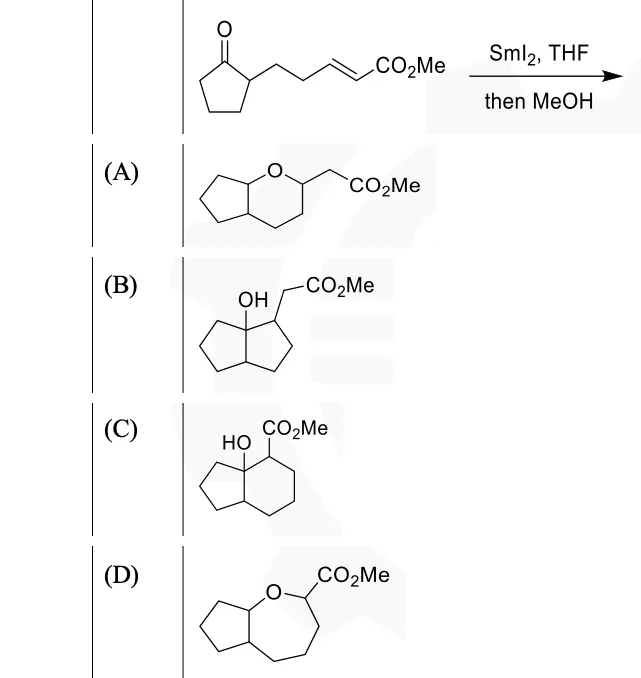
The major product formed in the following reaction is
SmIX2,THFthenMeOH
AStructure (A)
BStructure (B)
CStructure (C)
DStructure (D)
Show answer and explanation
Answer: B. Structure (B)
Reduction of the ketone by SmIX2 generates a ketyl radical at the carbonyl carbon. This radical undergoes a kinetically favored 5-exo-trig cyclization onto the β-position of the α,β-unsaturated ester rather than a 6-endo-trig closure. Subsequent single-electron transfer and protonation by MeOH afford the bicyclo[3.3.0]octanol derivative with a −CHX2COX2Me side chain as in (B). The alternative 6-endo-trig pathway leading to (C) is disfavored.
Answer: A. [Rh(CX5HX5)(P(CHX3)X3)(CX2HX5)]X+
For β-hydride elimination to occur readily, the complex must possess β-hydrogens and an accessible, vacant coordination site. The cationic complex [Rh(CX5HX5)(P(CHX3)X3)(CX2HX5)]X+ is a 16-electron species (Rh(III)d6+6e−+2e−+2e−), providing the empty site required for hydride transfer. Although (B) also contains an ethyl group, it is an 18-electron coordinatively saturated and kinetically inert octahedral complex, while ligands in (C) and (D) lack β-hydrogens.
According to molecular orbital theory, the correct ground state electronic configuration for [Co(NHX3)X6]X3+ ion is
Aa1g2t1u6eg4t2g6eg∗0
Ba1g2t1u6t2g6eg4eg∗0
Ct1u6a1g2eg4t2g6eg∗0
Da1g2t1u6eg4t2g4eg∗2
Show answer and explanation
Answer: A. a1g2t1u6eg4t2g6eg∗0
In octahedral [Co(NHX3)X6]X3+, the 12 electrons from the six σ-donor NHX3 ligands fill the bonding molecular orbitals in the energy order a1g<t1u<eg. The central CoX3+ is a d6 ion in a strong ligand field, adopting a low-spin state where all six d electrons pair into the non-bonding t2g level (t2g6) rather than entering the antibonding eg∗ set. Option D fails by assuming an incorrect high-spin configuration, while option B misplaces the non-bonding t2g below the bonding eg orbitals.
For [V(CO)X6]X−, vanadium contributes 5 valence electrons, each of the six CO ligands donates 2 electrons, and the negative charge adds 1, totaling 5+6(2)+1=18 electrons. Wilkinson's catalyst, [Rh(PPhX3)X3Cl] in option A, is a square planar 16-electron complex (9+3(2)+1=16), while options B and D have 19 and 20 valence electrons, respectively.
In allene (CHX2=C=CHX2), the two terminal CHX2 groups lie in mutually perpendicular planes due to the orthogonal π bonds on the central carbon. The molecule has a principal S4 improper axis collinear with a C2 axis along the carbon chain, two perpendicular C2′ axes, and two dihedral mirror planes (σd). Because it lacks a center of inversion and a σh plane, it belongs to the D2d point group. Option A (D2h) incorrectly assumes all atoms are coplanar.
Among the following, the one for which the infrared active vibrational modes are Raman inactive and *vice versa* is
AHX2O
B*trans*-planar conformer of HX2OX2
Ceclipsed conformer of ethane
DCHX4
Show answer and explanation
Answer: B. *trans*-planar conformer of HX2OX2
According to the rule of mutual exclusion, a molecule possesses mutually exclusive infrared and Raman active vibrational modes if and only if it has a center of inversion (i). The *trans*-planar conformer of HX2OX2 belongs to the C2h point group and has an inversion center, so no mode can be both IR and Raman active. Option C belongs to the D3h point group and lacks an inversion center (only staggered ethane, with D3d symmetry, possesses i).
For the following reaction, A+BXX‡product If the value of Δ‡Uo=25RT, then the value of Δ‡Ho is (XX‡ is an activated complex; Δ‡Uo is standard change in internal energy; Δ‡Ho is standard enthalpy of activation; R is gas constant; T is temperature)
A21RT
B23RT
C27RT
D25RT
Show answer and explanation
Answer: B. 23RT
For a bimolecular gas-phase reaction forming an activated complex, Δ‡ng=1−2=−1. Using the thermodynamic relation Δ‡Ho=Δ‡Uo+Δ‡ngRT, substituting the given value yields Δ‡Ho=25RT+(−1)RT=23RT. Option C incorrectly adds RT by taking Δ‡ng as +1.
55 more questions from this paper are in the app
In the Tatva app you get the whole paper with the real clock and marking, every answer explained, your score, and an AI tutor for each mistake.