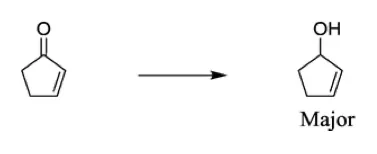
Among the following, the suitable reagents for the given transformation is:
AHX2,Pd/C
BHX2N−NHX2/KOH,Δ
CNaBHX4/CeClX3⋅7HX2O
DLi/Liq⋅NHX3
Show answer and explanation
Answer: C. NaBHX4/CeClX3⋅7HX2O
Luche reduction (NaBHX4/CeClX3) delivers hydride 1,2 to the enone carbonyl, giving the allylic alcohol cyclopent-2-en-1-ol while keeping the C=C. HX2,Pd/C (option A) is tempting but would reduce the C=C (conjugate reduction) instead.
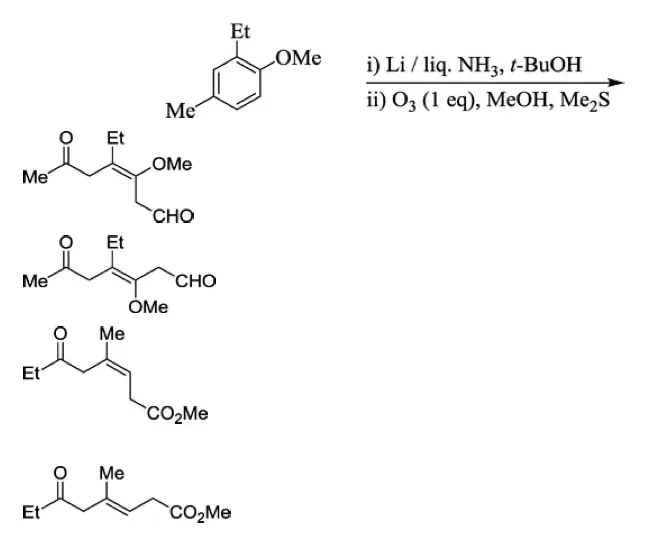
Major product formed in the following reaction sequence is:
AStructure (A)
BStructure (B)
CStructure (C)
DStructure (D)
Show answer and explanation
Answer: C. Structure (C)
Birch reduction leaves the OMe- and alkyl-bearing carbons as alkene carbons (1-methoxy-2-ethyl-4-methylcyclohexa-1,4-diene); one equivalent of OX3 cleaves the electron-rich enol-ether C=C, turning C(OMe) into a methyl ester and C(Et) into an ethyl ketone, giving EtCOCHX2C(Me)=CHCHX2COX2Me (C). Options A/B wrongly cleave the trisubstituted alkyl C=C and keep the enol ether.
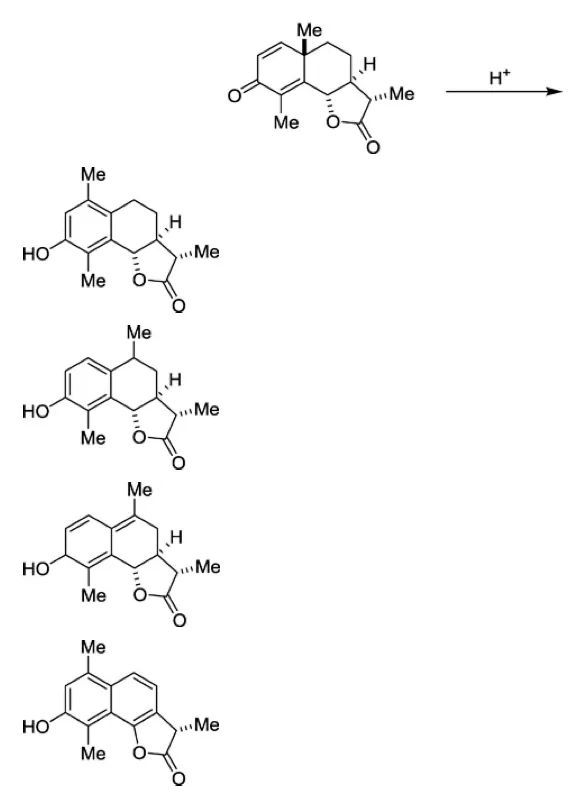
Major product formed in the following reaction is:
AStructure (A)
BStructure (B)
CStructure (C)
DStructure (D)
Show answer and explanation
Answer: A. Structure (A)
Acid triggers a dienone–phenol rearrangement: the protonated cross-conjugated dienone undergoes a 1,2-shift of the angular methyl to the adjacent ring carbon, and loss of HX+ aromatises the ring to the phenol A. Option D (full naphthalene) is tempting but requires an additional oxidation that acid alone cannot do.
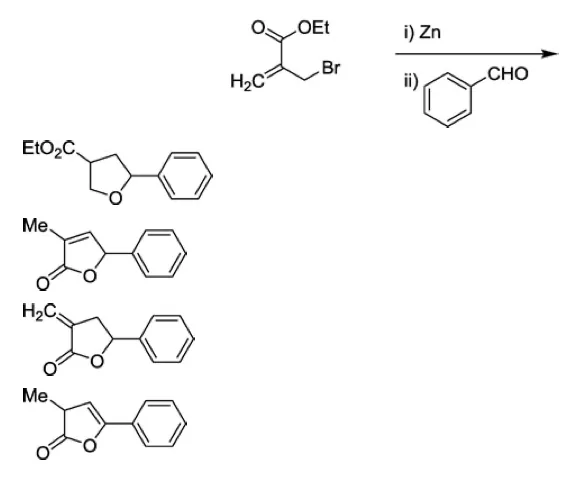
Major product formed in the following transformation is:
AStructure (A)
BStructure (B)
CStructure (C)
DStructure (D)
Show answer and explanation
Answer: C. Structure (C)
Zn inserts into the allylic C–Br to give an allylzinc (Barbier/Reformatsky-type) that adds to PhCHO through its terminal carbon; the resulting alkoxide then lactonises onto the ester, giving the α-methylene-γ-butyrolactone C. Option B (endocyclic, methyl-substituted butenolide) is the isomerised version that does not form under these conditions.
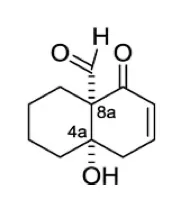
Absolute stereochemistry of the given compound is:
A4aR,8aS
B4aR,8aR
C4aS,8aS
D4aS,8aR
Show answer and explanation
Answer: D. 4aS,8aR
At C8a the priorities are C1 (ketone, O,O,C) > CHO (O,O,H) > C4a (O,C,C) > C8, and at C4a they are OH > C8a > C4 (allylic) > C5; with the drawn hashed CHO and OH these give 8a R and 4a S. The common error is ranking CHO above the ring ketone at C8a, which flips it to S (option C).
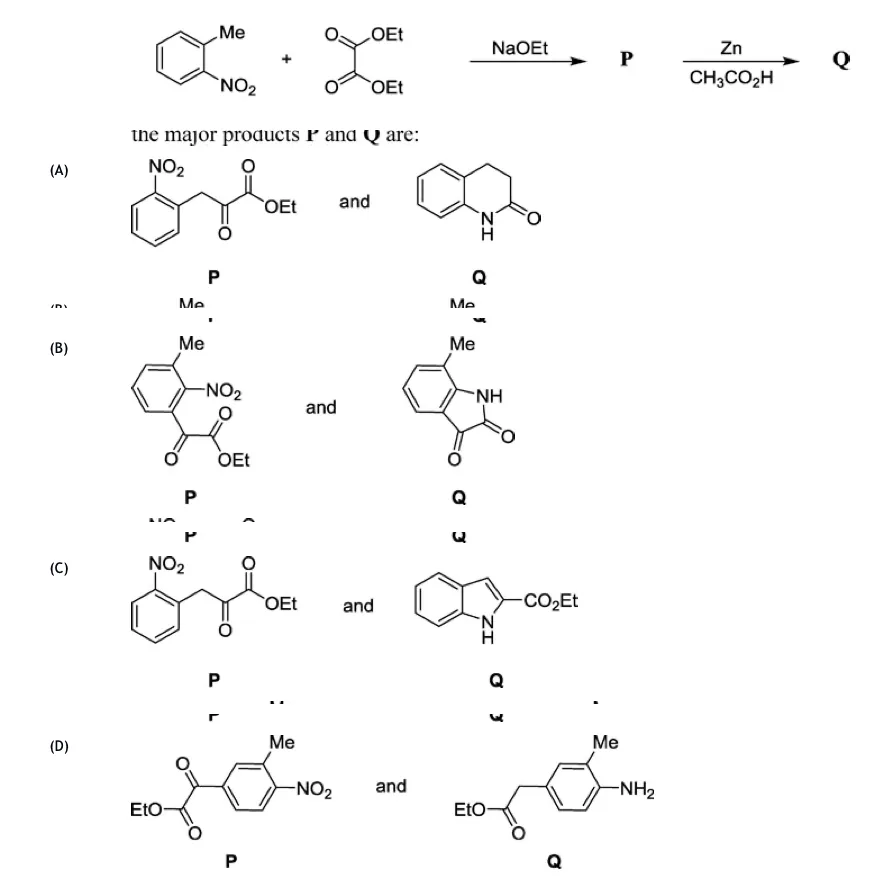
In the following reaction sequence, the major products P and Q are:
AStructure (A)
BStructure (B)
CStructure (C)
DStructure (D)
Show answer and explanation
Answer: C. Structure (C)
This is the Reissert indole synthesis: NaOEt deprotonates the acidic benzylic methyl of o-nitrotoluene, which condenses with diethyl oxalate to give ethyl o-nitrophenylpyruvate (P); Zn/AcOH reduces NOX2 to NHX2, which condenses with the ketone to give ethyl indole-2-carboxylate (Q). Option A shows the correct P but a lactam Q, which would need attack at the ester and loss of the ketone.
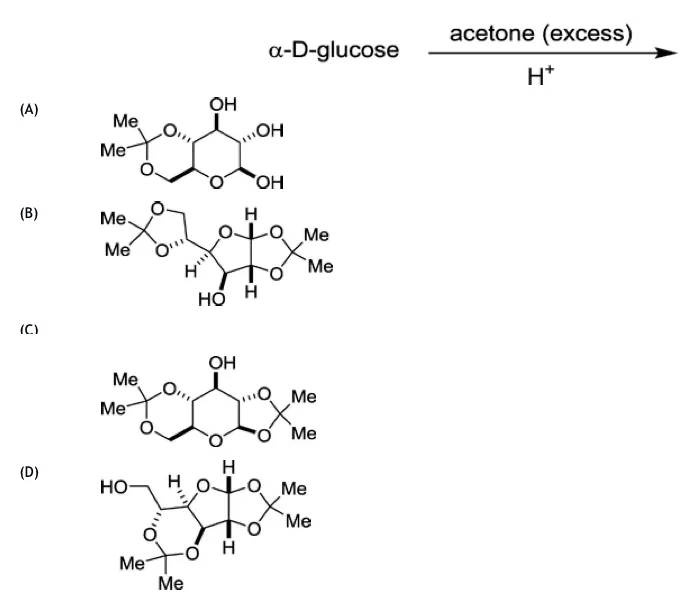
With excess acetone/HX+, glucose rearranges to the furanose so that it can form two five-membered cis-1,2 dioxolanes: 1,2:5,6-di-O-isopropylidene-α-D-glucofuranose ("diacetone glucose", B) with free 3-OH. Option C keeps the pyranose form, but there the 1,2-diol needed for a second acetonide is not suitably cis.
The CORRECT statement regarding the substitution of coordinated ligands in Ni(CO)X4 and Co(NO)(CO)X3 is:
(Given: Co−N−O bond is nearly linear; atomic numbers of Co and Ni are 27 and 28, respectively)
ANi(CO)X4 and Co(NO)(CO)X3 follow associative and dissociative pathways, respectively.
BNi(CO)X4 and Co(NO)(CO)X3 follow dissociative and associative pathways, respectively.
CBoth Ni(CO)X4 and Co(NO)(CO)X3 follow associative pathway.
DBoth Ni(CO)X4 and Co(NO)(CO)X3 follow dissociative pathway.
Show answer and explanation
Answer: B. Ni(CO)X4 and Co(NO)(CO)X3 follow dissociative and associative pathways, respectively.
Both complexes are 18-electron, so Ni(CO)X4 substitutes dissociatively; in Co(NO)(CO)X3 the linear 3e NO can bend to a 1e ligand, opening a site so an incoming ligand can add first (associative). Option D overlooks this NO linear-to-bent flexibility.
The CORRECT statement about hexagonal boron nitride is:
AIt is a good electrical conductor.
BIt has same layer stacking as that of graphite.
CIt is reactive towards fluorine.
DIt has lower thermal stability in air compared to that of graphite.
Show answer and explanation
Answer: C. It is reactive towards fluorine.
h-BN is an electrical insulator, stacks AA′ (B over N) rather than graphite's ABAB, and is more oxidation-resistant than graphite, but it does react with fluorine, so C is correct. Option B is the usual trap, since h-BN looks like graphite but its layers are eclipsed.
In oxyhemocyanin, the coordination number, mode of oxygen binding, color and the net magnetic behavior of copper ions, respectively are:
(Given: atomic number of Cu is 29)
AFour, μ-η1:η1-OX2X−, colorless and paramagnetic.
BFive, μ-η2:η2-OX2X−, colorless and paramagnetic.
CFive, μ-η2:η2-OX2X2−, blue and diamagnetic.
DFour, μ-η1:η1-OX2X2−, blue and diamagnetic.
Show answer and explanation
Answer: C. Five, μ-η2:η2-OX2X2−, blue and diamagnetic.
In oxyhemocyanin each Cu(II) is bound by three His plus the side-on bridging peroxide, μ-η2:η2-OX2X2− (CN = 5); it is blue, and the two d9 Cu(II) centres couple antiferromagnetically to give a diamagnetic site. Option D uses the end-on mode, which is wrong for hemocyanin.
55 more questions from this paper are in the app
In the Tatva app you get the whole paper with the real clock and marking, every answer explained, your score, and an AI tutor for each mistake.