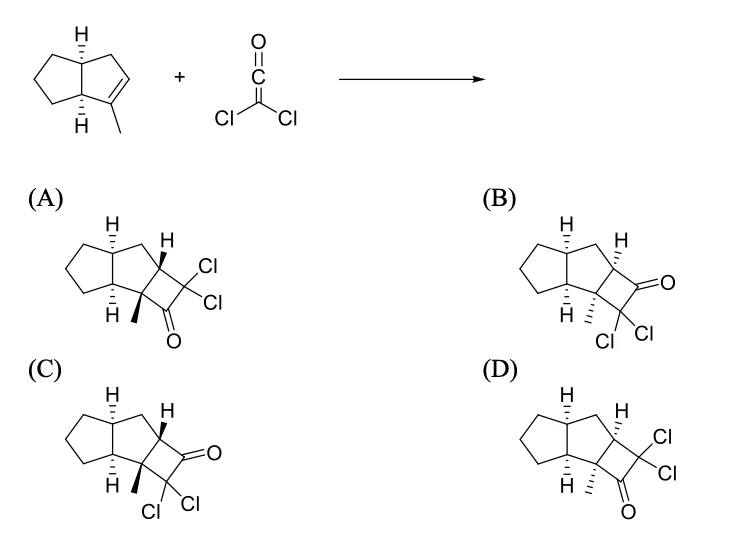
The major product formed in the following reaction (the bicyclic alkene cis-bicyclo[3.3.0]oct-2-ene bearing a methyl on the alkene carbon, with dichloroketene ClX2C=C=O) is
AStructure (A)
BStructure (B)
CStructure (C)
DStructure (D)
Show answer and explanation
Answer: C. Structure (C)
Dichloroketene adds suprafacially from the convex (exo) face; the nucleophilic, less substituted alkene carbon bonds to the ketene carbonyl carbon so that the CCl2 ends up next to the more substituted (methyl-bearing) carbon, giving C. Option A has the reverse regiochemistry.
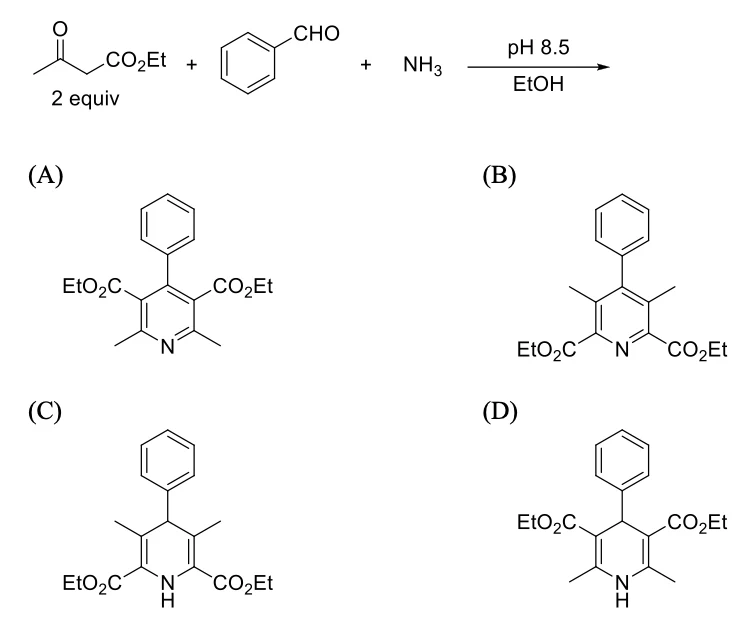
The major product formed in the following reaction is: ethyl acetoacetate (2 equiv) + benzaldehyde + NHX3 (pH 8.5, EtOH)
AStructure (A)
BStructure (B)
CStructure (C)
DStructure (D)
Show answer and explanation
Answer: D. Structure (D)
This is the Hantzsch synthesis: Knoevenagel adduct plus enamine condense to the 1,4-dihydropyridine with 2,6-dimethyl, 3,5-diester and 4-phenyl groups (D). Option A is the oxidised pyridine, which needs a separate oxidant.
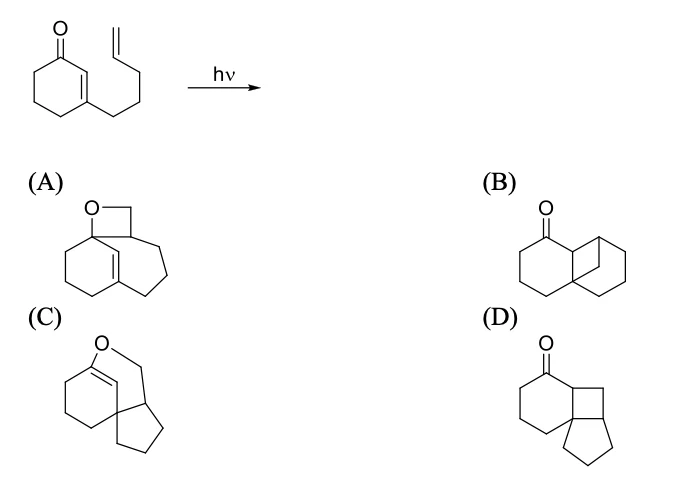
The major product of the following intramolecular photochemical (hν) cycloaddition reaction of 3-(pent-4-enyl)cyclohex-2-enone is
AStructure (A)
BStructure (B)
CStructure (C)
DStructure (D)
Show answer and explanation
Answer: D. Structure (D)
Enone–alkene [2+2] photocycloaddition follows the 'rule of five': the first bond forms to make a five-membered ring, giving the crossed-free fused cyclobutane with a cyclopentane (D). Option B is the bridged alternative, and A/C are Paternò–Büchi-type oxetanes.
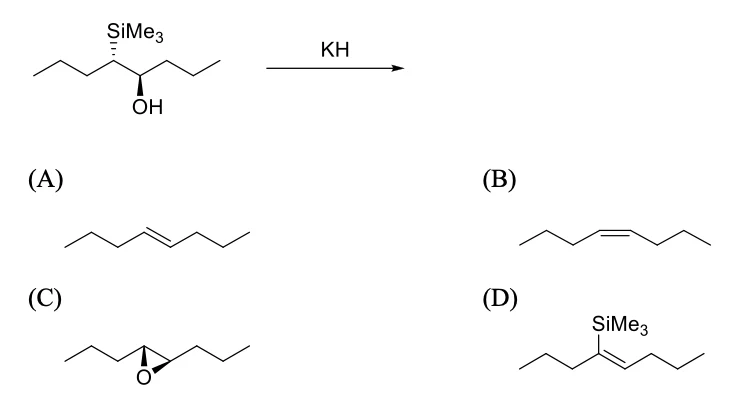
The major product of the following reaction of the stereodefined β-hydroxysilane, 4-(trimethylsilyl)octan-5-ol, with KH is
AStructure (A)
BStructure (B)
CStructure (C)
DStructure (D)
Show answer and explanation
Answer: B. Structure (B)
Under basic conditions (KH) the Peterson elimination is syn, via a four-membered Si–O intermediate; for the drawn relative configuration this gives (Z)-oct-4-ene. Option A, the E-alkene, results from acid-promoted anti elimination.
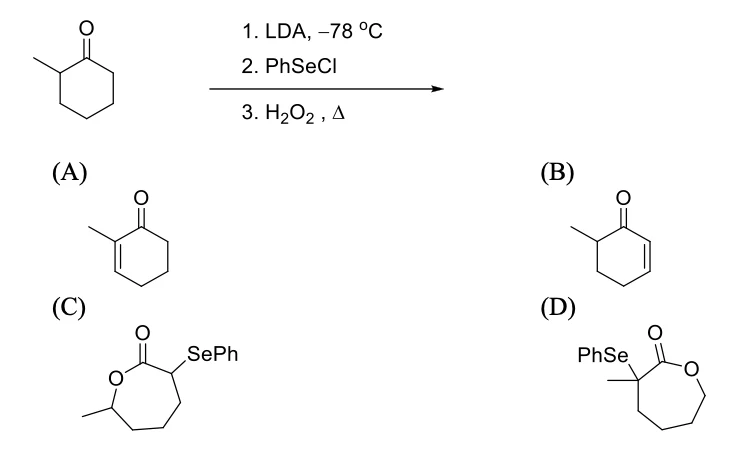
The major product formed in the following reaction sequence of 2-methylcyclohexanone (1. LDA, −78∘C; 2. PhSeCl; 3. HX2OX2, Δ) is
AStructure (A)
BStructure (B)
CStructure (C)
DStructure (D)
Show answer and explanation
Answer: B. Structure (B)
LDA at −78 °C gives the kinetic enolate at the less substituted CH2; selenenylation there and syn selenoxide elimination give 6-methylcyclohex-2-enone (B). Option A would arise from the thermodynamic enolate.
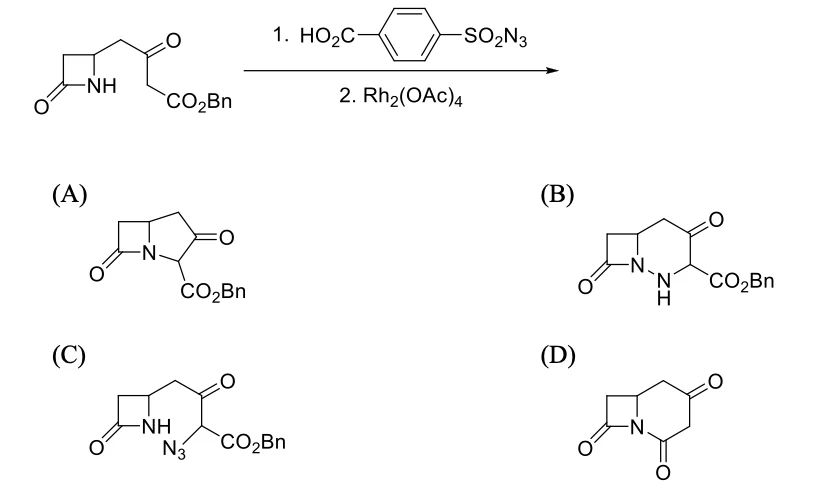
The major product formed in the following reaction sequence of the azetidinone β-keto benzyl ester (1. 4-carboxybenzenesulfonyl azide; 2. RhX2(OAc)X4) is
AStructure (A)
BStructure (B)
CStructure (C)
DStructure (D)
Show answer and explanation
Answer: A. Structure (A)
The sulfonyl azide does a diazo transfer to the active methylene; Rh2(OAc)4 then forms a carbenoid that inserts into the β-lactam N–H, closing the five-membered ring of the carbapenam (A). Option C keeps an azide, which is not what diazo transfer gives.
The spherical harmonic function, Yl,m(θ,ϕ), with appropriate values of l and m, is an eigenfunction of L^x2+L^y2 operator. The corresponding eigenvalue is
A(l(l+1)−m2)ℏ2
B(l(l+1)+m2)ℏ2
Cl(l+1)ℏ2
Dm2ℏ2
Show answer and explanation
Answer: A. (l(l+1)−m2)ℏ2
L^x2+L^y2=L^2−L^z2, whose eigenvalue on Yl,m is l(l+1)ℏ2−m2ℏ2. Option C is the eigenvalue of L^2 alone.
Consider the operators, a^+=21(x^+ip^x) and a^−=21(x^−ip^x), where x^ and p^x are the position and linear momentum operators, respectively. The commutator, [a^+,a^−] is equal to
Aiℏ
B−iℏ
Cℏ
D−ℏ
Show answer and explanation
Answer: C. ℏ
[a^+,a^−]=21(−i[x^,p^x]+i[p^x,x^])=21(ℏ+ℏ)=ℏ. Option D results from a sign slip in [x^,p^x]=iℏ.
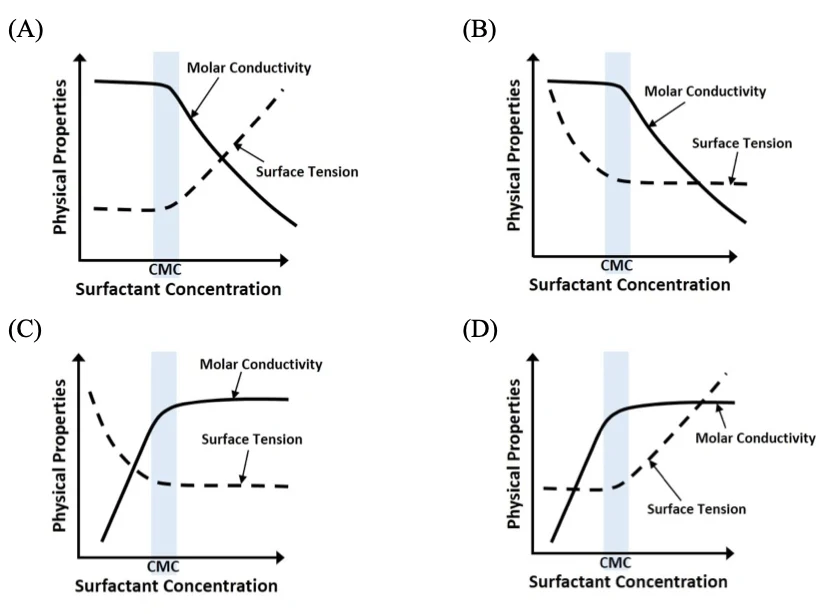
For an ionic micelle-forming surfactant near its critical micelle concentration (CMC), the dependence of molar conductivity and surface tension on surfactant concentration is best represented by
AStructure (A)
BStructure (B)
CStructure (C)
DStructure (D)
Show answer and explanation
Answer: B. Structure (B)
Molar conductivity drops sharply above the CMC as ions bind into micelles, while surface tension falls until the CMC and then levels off (B). Option A wrongly shows surface tension rising.
55 more questions from this paper are in the app
In the Tatva app you get the whole paper with the real clock and marking, every answer explained, your score, and an AI tutor for each mistake.