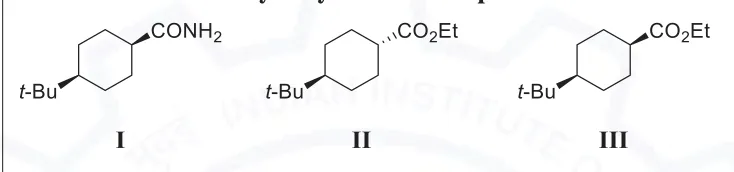
The rates of alkaline hydrolysis of the compounds shown below
follow the order:
AI>II>III
BII>I>III
CII>III>I
DIII>I>II
Show answer and explanation
Answer: C. II>III>I
Esters undergo alkaline hydrolysis much faster than amides because amides are stabilized by stronger resonance donation and have a poorer leaving group, making amide I the slowest. Between the esters, the bulky t-butyl group locks both rings into a chair conformation with t-butyl equatorial. In trans-isomer II, the −COX2Et group is equatorial and readily accessible, whereas in cis-isomer III, it is axial and sterically hindered by 1,3-diaxial interactions. Thus, the rate follows II>III>I; Option B fails by ranking the amide ahead of an ester.
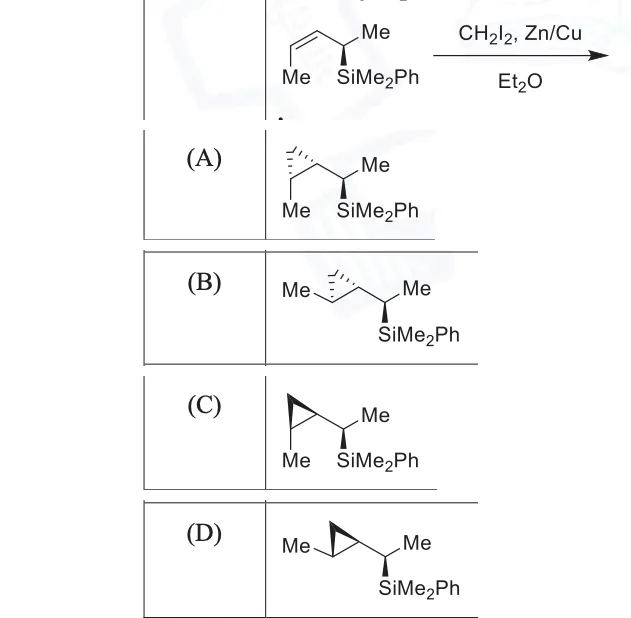
The major product formed in the following reaction is:
AStructure (A)
BStructure (B)
CStructure (C)
DStructure (D)
Show answer and explanation
Answer: A. Structure (A)
The substrate is a (Z)-alkene, and Simmons-Smith cyclopropanation with CHX2IX2 and Zn/Cu is stereospecific, so the ring methyl and the side chain must end up cis on the cyclopropane; this rules out options B and D, which show trans-disubstituted rings. In a (Z)-alkene, allylic 1,3-strain holds the allylic C-H roughly eclipsed with the double bond, so the bulky wedged −SiMeX2Ph group sits over one face of the alkene. The zinc carbenoid therefore delivers CHX2 from the opposite (dashed) face, giving option A; option C is the minor diastereomer from attack on the face shielded by silicon.
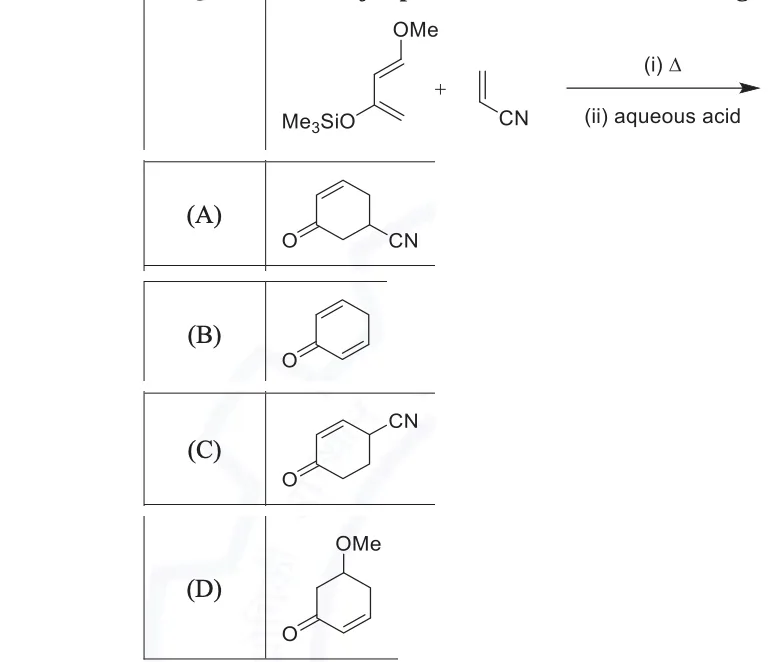
The major product formed in the following reaction
is:
AStructure (A)
BStructure (B)
CStructure (C)
DStructure (D)
Show answer and explanation
Answer: C. Structure (C)
Danishefsky's diene undergoes a regioselective Diels-Alder cycloaddition with acrylonitrile. The strongly electron-donating −OMe and −OTMS groups direct the most nucleophilic terminal carbon of the diene to bond with the less substituted, electrophilic β-carbon of acrylonitrile, placing the −CN group adjacent to the −OMe-bearing carbon. Subsequent acid-catalyzed hydrolysis of the silyl enol ether followed by elimination of methanol establishes the α,β-unsaturated cyclohexenone core with the −CN group at the allylic position, yielding (C). Option A has the incorrect regiochemical orientation.
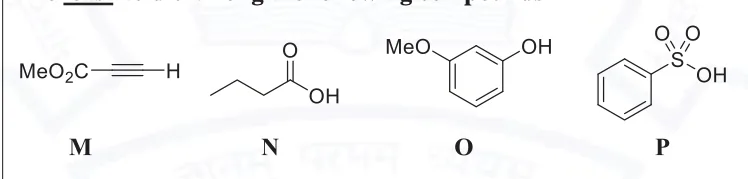
Acidity is determined by the stability of the conjugate base and the electronegativity of the deprotonated atom. Compounds P (sulfonic acid, pKa<0), N (carboxylic acid, pKa≈4.8), and O (phenol, pKa≈9.6) all form resonance-stabilized oxyanions upon deprotonation. In M, the acidic proton is attached to an sp-carbon; even with inductive stabilization from the ester, the resulting acetylide carbanion (pKa≈18) is vastly less stable. Option C is tempting as a weak acid, but its O−H proton is still millions of times more acidic than M's C−H.
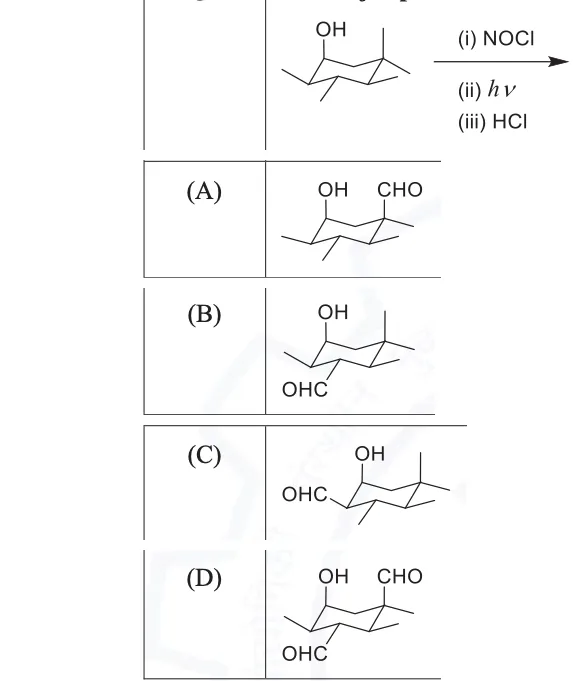
The major product formed in the following reaction is:
AStructure (A)
BStructure (B)
CStructure (C)
DStructure (D)
Show answer and explanation
Answer: A. Structure (A)
This reaction is the Barton reaction, where reaction of the alcohol with NOCl followed by photolysis generates an axial alkoxyl radical. This radical selectively abstracts a hydrogen atom from the co-facial 1,3-diaxial methyl group via a six-membered chair-like transition state (1,5-hydrogen shift). Subsequent radical trapping by NOX∙, oxime tautomerization, and acidic hydrolysis yields the axial formyl group (−CHO). Options B and C are incorrect because equatorial methyl groups cannot achieve the required 1,3-diaxial spatial geometry for intramolecular abstraction.
The reagent(s) required for the conversion of hex-3-yne to (E)-hex-3-ene is/are:
AHX2,Pd/BaSOX4
BBuX3SnH
CLi/liquidNHX3
DLiAlHX4
Show answer and explanation
Answer: C. Li/liquidNHX3
Dissolving metal reduction using Li/liquidNHX3 reduces internal alkynes via anti-addition through the more stable trans-radical anion intermediate, selectively yielding the (E)-alkene. In contrast, Lindlar's catalyst (option A, HX2,Pd/BaSOX4) carries out syn-addition to give the (Z)-alkene.
An organic compound exhibits the [M]+, [M+2]+ and [M+4]+ peaks in the intensity ratio 1:2:1 in the mass spectrum, and shows a singlet at δ 7.49 in the 1H NMR spectrum in CDClX3. The compound is:
A1,4-dichlorobenzene
B1,4-dibromobenzene
C1,2-dibromobenzene
D1,2-dichlorobenzene
Show answer and explanation
Answer: B. 1,4-dibromobenzene
The [M]+:[M+2]+:[M+4]+ intensity ratio of 1:2:1 arises from the binomial expansion (1+1)2 for two bromine atoms (79Br and 81Br in approximately 1:1 abundance), eliminating chlorine-containing options A and D, which show a 9:6:1 ratio. The single 1H NMR peak indicates four chemically and magnetically equivalent aromatic protons, which corresponds to the symmetric 1,4-dibromobenzene. Option C has two sets of inequivalent protons forming an AA′BB′ multiplet rather than a singlet.
Reaction of LiAlHX4 with one equivalent of MeX3N⋅HCl gives a tetrahedral compound, which reacts with another equivalent of MeX3N⋅HCl to give compound N. The compound N and its geometry, respectively, are:
ALiAlHX4NMeX3 and trigonal bipyramidal
BLiX2AlHX4Cl and square pyramidal
CAlHX3(NMeX3)X2 and trigonal bipyramidal
DAlHX3(NMeX3)X2 and pentagonal
Show answer and explanation
Answer: C. AlHX3(NMeX3)X2 and trigonal bipyramidal
Reaction of LiAlHX4 with one equivalent of MeX3N⋅HCl yields the tetrahedral adduct AlHX3(NMeX3) along with LiCl and HX2. Subsequent addition of a second equivalent of MeX3N forms the 5-coordinate bis-adduct AlHX3(NMeX3)X2, which adopts a trigonal bipyramidal geometry (D3h) with axial trimethylamine ligands and equatorial hydrides. Option D is incorrect because a 5-coordinate complex cannot have a pentagonal geometry.
Hemocyanin is a non-heme metalloprotein that binds oxygen using a dinuclear copper active site coordinated directly to histidine residues, completely lacking a porphyrin ring. In contrast, hemoglobin (A), myoglobin (C), and cytochrome P-450 (D) are all heme proteins containing an iron-porphyrin prosthetic group.
A nucleotide consists of a nitrogenous base, a pentose sugar, and at least one phosphate group. Adenosine monophosphate (AMP) contains adenine, ribose, and a phosphate group, making it a complete nucleotide. In contrast, uridine (option C) is a nucleoside because it lacks a phosphate moiety, while RNA and DNA are polynucleotides.
55 more questions from this paper are in the app
In the Tatva app you get the whole paper with the real clock and marking, every answer explained, your score, and an AI tutor for each mistake.