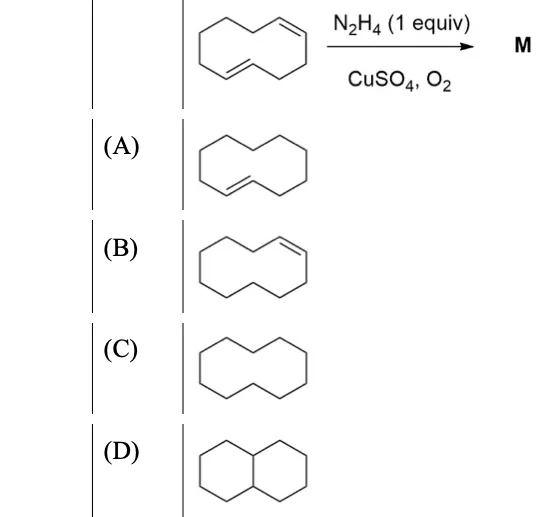
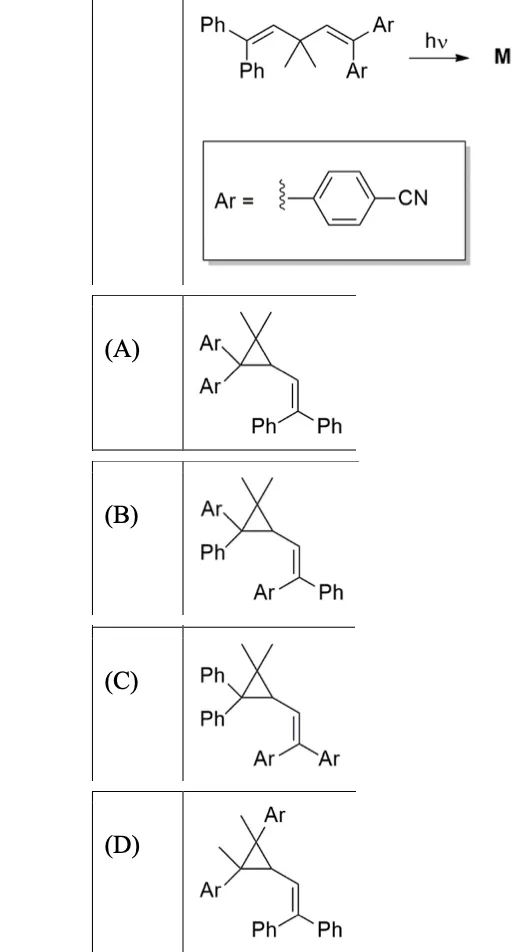
The major product M formed in the following reaction is
AStructure (A)
BStructure (B)
CStructure (C)
DStructure (D)
Show answer and explanation
Answer: B. Structure (B)
Diimide (HN=NH), generated in situ from NX2HX4 and OX2 catalyzed by CuSOX4, selectively reduces more strained and sterically accessible alkenes. In a 10-membered ring, the (E)-double bond is significantly more strained than the (Z)-double bond, so it undergoes reduction much more rapidly with 1 equivalent of diimide. Consequently, the (E)-alkene is reduced while the (Z)-alkene remains intact, yielding (B). Option A incorrectly retains the more strained (E)-double bond.
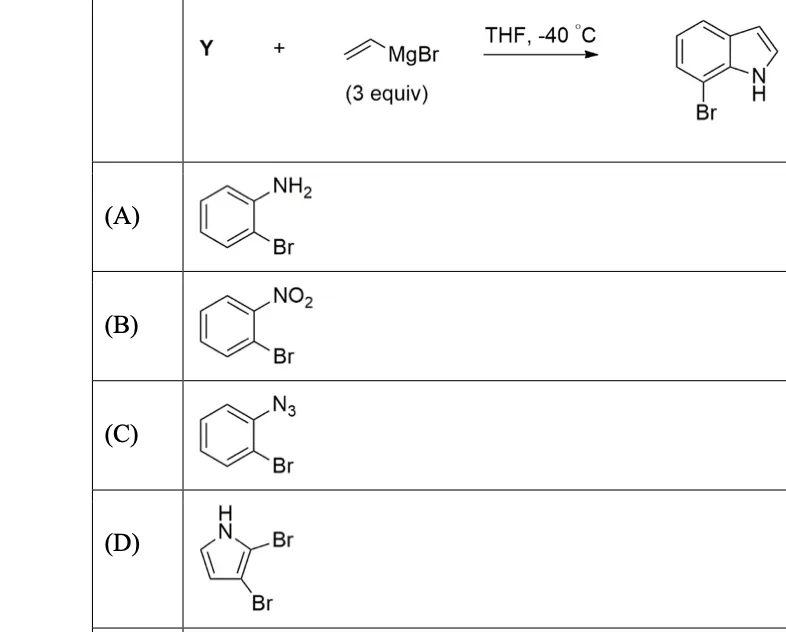
The starting material Y in the following reaction is
AStructure (A)
BStructure (B)
CStructure (C)
DStructure (D)
Show answer and explanation
Answer: B. Structure (B)
This reaction is the Bartoli indole synthesis, in which an ortho-substituted nitroarene reacts with three equivalents of vinylmagnesium bromide to yield an indole derivative. Therefore, 1-bromo-2-nitrobenzene (B) is the starting material required to produce 7-bromoindole. The amino group in (A) fails because it is merely deprotonated by the Grignard reagent instead of undergoing addition.
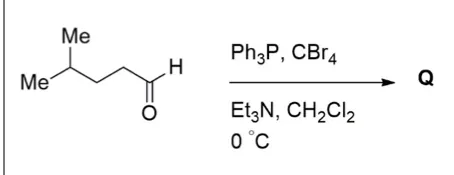
The major product in the given reaction is Q. The mass spectrum of Q shows {[M] = molecular ion peak}
A[M], [M+2] and [M+4] with relative intensity of 1:2:1
B[M] and [M+2] with relative intensity of 1:1
C[M], [M+2] and [M+4] with relative intensity of 1:3:1
D[M] and [M+2] with relative intensity of 2:1
Show answer and explanation
Answer: A. [M], [M+2] and [M+4] with relative intensity of 1:2:1
Reaction of an aldehyde with PhX3P and CBrX4 is the Ramirez dibromoolefination (the first stage of the Corey-Fuchs reaction), converting the carbonyl group into a 1,1-dibromoalkene containing two bromine atoms. Since 79Br and 81Br naturally occur in approximately a 1:1 ratio, the isotopic peak distribution for BrX2 is given by (1+1)2=1:2:1 for [M], [M+2], and [M+4]. Option B corresponds to a compound containing only one bromine atom.
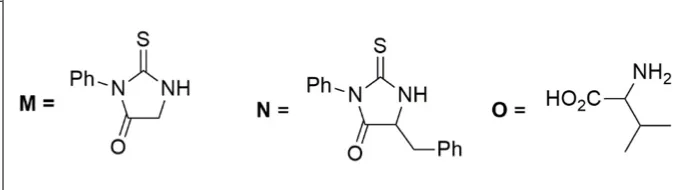
A tripeptide on treatment with PhNCS (pH=8.0) followed by heating with dilute HCl afforded a cyclic compound M and a dipeptide. The dipeptide on treatment with PhNCS (pH=8.0) followed by heating with dilute HCl afforded a cyclic compound N and an acyclic compound O. The CORRECT sequence (from N- to C-terminus) of the tripeptide is
Aglycine-phenylalanine-valine
Bvaline-phenylalanine-glycine
Cglycine-tyrosine-valine
Dglycine-phenylalanine-alanine
Show answer and explanation
Answer: A. glycine-phenylalanine-valine
Edman degradation sequentially cleaves amino acids from the N-terminus as phenylthiohydantoin (PTH) derivatives. Compound M lacks a side chain at the α-position, identifying the N-terminal residue as glycine. Compound N contains a benzyl side chain (−CHX2Ph), corresponding to phenylalanine as the second residue, while the remaining free amino acid O has an isopropyl group, identifying the C-terminal residue as valine. Thus, the sequence is glycine-phenylalanine-valine; option B inverts the sequence direction.
On direct irradiation the 1,4-diene undergoes a di-π-methane rearrangement. Bonding between the two inner alkene carbons forms a cyclopropane carrying radical centres at the CPhX2 and CArX2 carbons (Ar = 4-cyanophenyl). The three-membered ring then opens on the side that keeps the better-stabilised radical: the 4-cyanophenyl groups delocalise the odd electron better than phenyl, so the CArX2 radical survives while the CPhX2 end becomes a C=C bond. Closure of the new 1,3-diradical puts the CArX2 carbon into the cyclopropane with a CH=CPhX2 side chain, which is option A; option C would require keeping the less stabilised PhX2CX∙ radical instead.
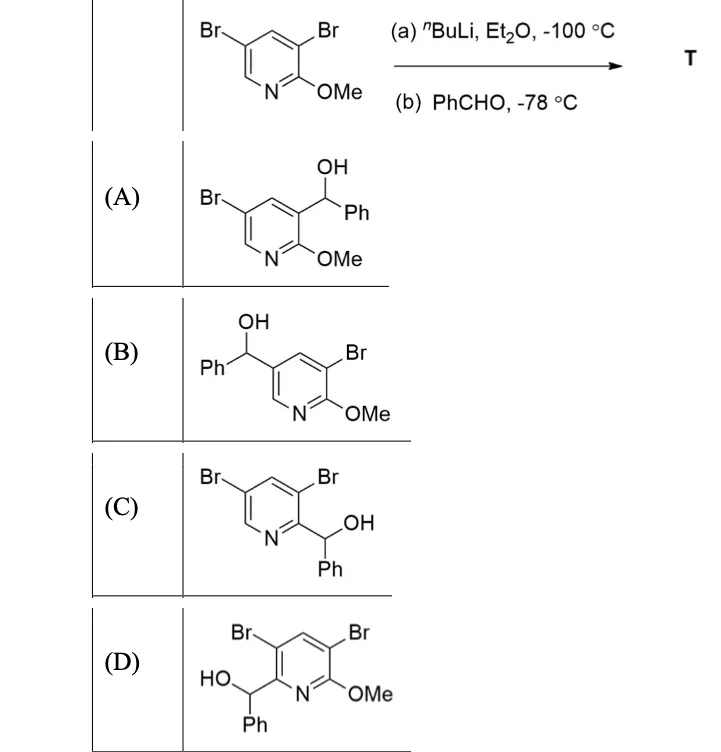
The major product T formed in the following reaction is
AStructure (A)
BStructure (B)
CStructure (C)
DStructure (D)
Show answer and explanation
Answer: A. Structure (A)
Halogen-lithium exchange of 3,5-dibromo-2-methoxypyridine with n-BuLi at −100∘C occurs regioselectively at the C-3 bromine. The adjacent methoxy oxygen facilitates this exchange through inductive stabilization and coordination to lithium. Subsequent nucleophilic addition of the resulting 3-lithiated intermediate to benzaldehyde yields the secondary alcohol at C-3, giving (A). Option B fails because exchange at C-5 lacks this proximal heteroatom coordination.
Athe temperature differences between the sample and reference are measured as a function of temperature
Bthe differences in heat flow into the reference and sample are measured as a function of temperature
Cthe change in the mass of the sample is measured as a function of temperature
Dthe glass transition is observed as a sharp peak
Show answer and explanation
Answer: A. the temperature differences between the sample and reference are measured as a function of temperature
In differential thermal analysis (DTA), the temperature difference (ΔT=Tsample−Treference) between the sample and an inert reference material is measured as a function of furnace temperature. Option B describes differential scanning calorimetry (DSC), which monitors differences in heat flow, while option C describes thermogravimetric analysis (TGA).
The νO−O resonance Raman stretching frequency (cm−1) of the coordinated dioxygen in *oxy-hemoglobin* and *oxy-hemocyanin* appears, respectively, nearly at
A1136 and 744
B1550 and 744
C744 and 1136
D744 and 1550
Show answer and explanation
Answer: A. 1136 and 744
In oxy-hemoglobin, dioxygen binds end-on as a superoxo group (OX2X−), giving a characteristic νO−O stretching frequency in the superoxide range near 1136 cm−1. In oxy-hemocyanin, dioxygen bridges two Cu(II) centers as a side-on peroxo ligand (OX2X2−), lowering the bond order and shifting νO−O into the peroxide range near 744 cm−1. Option C reverses the values for the two metalloproteins.
The number of metal-metal bond(s), with σ, π, and δ character, present in [MoX2(CHX3COX2)X4] complex is(are), respectively,
A1, 2, 1
B1, 2, 0
C1, 1, 0
D1, 1, 1
Show answer and explanation
Answer: A. 1, 2, 1
In [MoX2(CHX3COX2)X4], each Mo(II) center is d4, providing 8 valence electrons to the dimetal core. These occupy the metal-metal bonding orbitals as σ2π4δ2, yielding a quadruple bond with a bond order of 4 that consists of one σ, two π, and one δ bond. Option B mistakenly neglects the δ bond formed by the face-to-face overlap of dxy orbitals.
1sA and 1sB are the normalized eigenfunctions of two hydrogen atoms HA and HB, respectively. If S=⟨1sA∣1sB⟩, the option that is ALWAYS CORRECT is
AS=1
BS=0
CS=imaginary constant
D0≤S≤1
Show answer and explanation
Answer: D. 0≤S≤1
The overlap integral S=⟨1sA∣1sB⟩ between two identical, normalized, real-valued 1s orbitals is strictly real and non-negative because 1s wavefunctions are everywhere positive. Its value varies continuously with the internuclear distance R, reaching S=1 at R=0 and approaching S=0 as R→∞, which restricts S to 0≤S≤1. Options A and B fail because they are true only at the specific limits of zero and infinite separation, respectively.
55 more questions from this paper are in the app
In the Tatva app you get the whole paper with the real clock and marking, every answer explained, your score, and an AI tutor for each mistake.