Tatva

GATE Chemistry

GATE 2015: questions with answers and explanations

10 of the 63 questions, with answers and explanations. The full paper is in the Tatva app. Answers follow the official final key.

Question 1Quantum chemistry
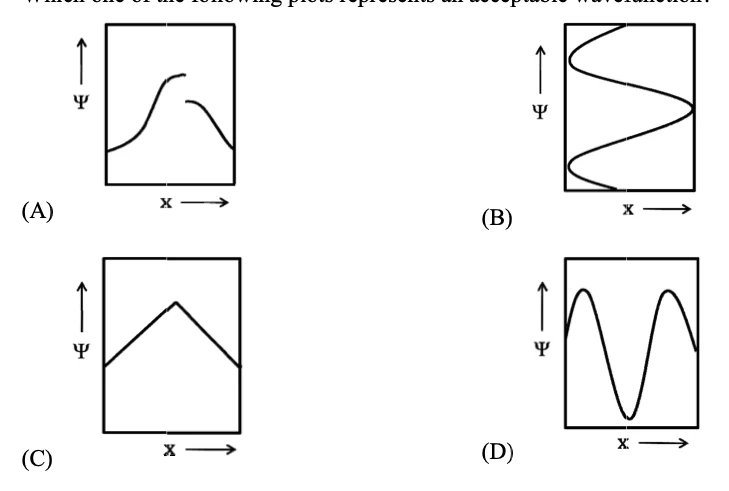
Which one of the following plots represents an acceptable wavefunction? (Four plots of versus .)
Question 1
  1. AStructure (A)
  2. BStructure (B)
  3. CStructure (C)
  4. DStructure (D)
Show answer and explanation

Answer: D. Structure (D)

An acceptable must be single-valued, continuous and have a continuous first derivative; (D) satisfies all, while (A) is discontinuous, (B) is multivalued and (C) has a kink.
Question 2Quantum chemistry
When the operator operates on the function , the result is
  1. A
  2. B
  3. C
  4. D
Show answer and explanation

Answer: A.

, so the operator gives ; the factor cancels on the second differentiation.
Question 3Thermodynamics
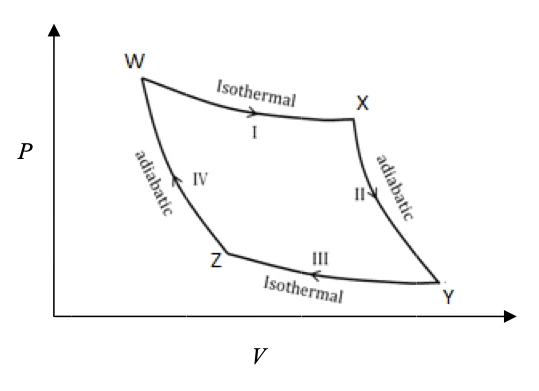
From the above Carnot cycle undergone by an ideal gas (W to X isothermal I, X to Y adiabatic II, Y to Z isothermal III, Z to W adiabatic IV), identify the processes in which the change in internal energy is NON-ZERO.
Question 3
  1. AI and II
  2. BII and IV
  3. CII and III
  4. DI and IV
Show answer and explanation

Answer: B. II and IV

For an ideal gas in the isothermal steps; temperature changes only in the adiabatic steps II and IV.
Question 4Statistical thermodynamics
For an ideal gas with molar mass , the molar translational entropy at a given temperature is proportional to
  1. A
  2. B
  3. C
  4. D
Show answer and explanation

Answer: D.

Sackur-Tetrode: contains with , so varies as ; is the partition function dependence, not entropy.
Question 5Thermodynamics
Which one of the following defines the absolute temperature of a system?
  1. A
  2. B
  3. C
  4. D
Show answer and explanation

Answer: A.

From , ; equals only at constant .
Question 6Solutions
Which of the following properties are characteristic of an ideal solution?
I. is negative
II. is positive
III. is positive
IV. is negative
  1. AI and IV
  2. BI and II
  3. CI and III
  4. DIII and IV
Show answer and explanation

Answer: B. I and II

For an ideal solution and , while and hence .
Question 7Chemical equilibrium
The expression for the equilibrium constant () for the enzyme catalyzed reaction given below, is
  1. A
  2. B
  3. C
  4. D
Show answer and explanation

Answer: A.

Overall , the product of forward over reverse rate constants.
Question 9Electronic spectra
The absorption spectrum of in solution comprises of a maximum with a shoulder. The reason for the shoulder is
  1. Aligand-to-metal charge transfer (LMCT)
  2. Bmetal-to-ligand charge transfer (MLCT)
  3. CJahn-Teller distortion
  4. Dnephelauxetic effect
Show answer and explanation

Answer: C. Jahn-Teller distortion

The excited state () is Jahn-Teller split, so the single band shows a shoulder; it is a d-d band, not charge transfer.
Question 10Main group
The ease of formation of the adduct, (where, X = F, Cl, Br) follows the order
  1. A
  2. B
  3. C
  4. D
Show answer and explanation

Answer: C.

Lewis acidity increases because B-X back-bonding, strongest for F, must be lost on pyramidalisation; the electronegativity-based order (A) is the trap.

Question 11Organometallics
An efficient catalyst for hydrogenation of alkenes is . However, does not catalyze this reaction, because
  1. A binds stronger to Ir than to Rh
  2. BCl binds stronger to Ir than to Rh
  3. C binds stronger to Rh than to Ir
  4. DCl binds stronger to Rh than to Ir
Show answer and explanation

Answer: A. binds stronger to Ir than to Rh

The catalytic cycle needs dissociation to open a site; the stronger Ir-P bond (5d metal) prevents this.

53 more questions from this paper are in the app

In the Tatva app you get the whole paper with the real clock and marking, every answer explained, your score, and an AI tutor for each mistake.

  • Organic17
  • Physical13
  • General Aptitude9
  • Inorganic9
  • Spectroscopy3
  • Analytical2

More GATE Chemistry papers