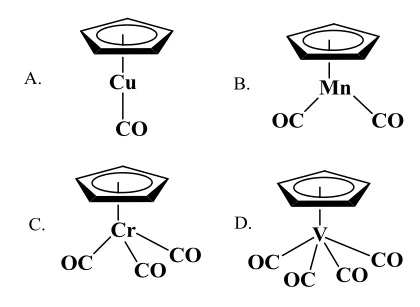
Identify the species, those obey the 18 electron rule, from the following:
AA and B
BB and C
CC and D
DA and D
Show answer and explanation
Answer: D. A and D
Using the neutral electron counting method with η5-Cp donating 5 e− and each CO donating 2 e−, complex A gives 11(Cu)+5+2=18 e−, and complex D gives 5(V)+5+4(2)=18 e−. In contrast, complex B has only 7(Mn)+5+2(2)=16 e−, and complex C is an open-shell 17 e− species (6+5+6=17 e−). Thus, only A and D satisfy the 18-electron rule, making option D correct while options A, B, and C fail.
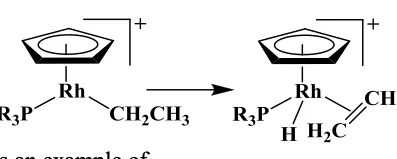
In this transformation, the ethyl group transfers a hydrogen atom from its β-carbon to the rhodium center, converting the σ-alkyl ligand into a hydride and a coordinated ethylene (alkene) ligand. This directly corresponds to the definition of β-hydride elimination. Option B is incorrect because migratory insertion is the exact reverse process, where a hydride adds across the coordinated alkene to form an alkyl group.
[NiXIILX6]Xn+ or n− shows absorption bands at 8500, 15400, and 26000 cm−1 whereas [NiXIILX6′]Xn+ or n−, at 10750, 17500, and 28200 cm−1. L and L′ are respectively,
AOHX− and NX3X−
BClX− and IX−
CNCSX− and RCOX2X−
DHX2O and NHX3
Show answer and explanation
Answer: D. HX2O and NHX3
For an octahedral d8Ni(II) complex, the lowest-energy band (3A2g→3T2g) directly gives Δo. Here, Δo(L)=8500 cm−1 and Δo(L′)=10750 cm−1, which are the standard values for [Ni(HX2O)X6]X2+ and [Ni(NHX3)X6]X2+, respectively. Because Δo(L′)>Δo(L), L′ must be higher in the spectrochemical series; options B and C fail as they place the weaker-field ligand as L′.
The total number of microstates for an atomic term 2S+1L is given by (2S+1)(2L+1). For the 3F term, the spin multiplicity (2S+1)=3 and for an F state L=3, giving an orbital degeneracy of 2(3)+1=7. Multiplying these gives 3×7=21 microstates. Option C incorrectly assumes (2S+1)2 or miscounts the orbital degeneracy.
CpM [Cp is (η5−CX5HX5)] fragment isolobal with a BH fragment is
ACpGe
BCpMn
CCpRu
DCpCo
Show answer and explanation
Answer: D. CpCo
A main-group fragment with n valence electrons is isolobal to a transition-metal fragment with n+10 electrons. The BH fragment has 3+1=4 valence electrons, so its isolobal transition-metal analogue must have 4+10=14 valence electrons. Because η5-Cp donates 5 electrons, the metal center must supply 14−5=9 valence electrons, which uniquely matches group 9 cobalt in CpCo. Option C fails because CpRu possesses only 8+5=13 valence electrons.
The number of metal-metal bonds in [CoX2FeX2(CO)X11(μ4−PPh)2] is
A3
B4
C5
D6
Show answer and explanation
Answer: B. 4
The total valence electron count is TEC=2(9)+2(8)+11(2)+2(4)=64, where each bridging μ4-PPh ligand donates 4 electrons. The number of metal-metal bonds is given by (18n−TEC)/2=(18×4−64)/2=4. Option D incorrectly assumes a closed tetrahedral core requiring 6 bonds and 60 electrons.
In homonuclear diatomic molecules like BX2, side-by-side overlap of atomic p orbitals produces bonding π orbitals that invert sign through the center of symmetry, making them ungerade (πu). Conversely, the antibonding π∗ orbitals have lobes of identical phase related through the inversion center, making them gerade (πg∗). Option A reverses this symmetry by erroneously assigning σ-orbital inversion behavior to π orbitals.
The correct shape of [TeFX5]− ion on the basis of VSEPR theory is
ATrigonal bipyramidal
BSquare pyramidal
CPentagonal planar
DSee-saw
Show answer and explanation
Answer: B. Square pyramidal
Tellurium has 6 valence electrons, so [TeFX5]− has a steric number of (6+5+1)/2=6. This corresponds to an AX5E system with 5 bond pairs and 1 lone pair arranged in an octahedral electron-pair geometry. The resulting molecular shape is square pyramidal. Option A is incorrect because it overlooks the lone pair and assumes an AX5 geometry.
The numbers of P-S and P-P bonds in the compound PX4SX3 are, respectively,
A6 and 3
B4 and 3
C3 and 6
D6 and 2
Show answer and explanation
Answer: A. 6 and 3
The molecule PX4SX3 adopts a cage structure where an apical phosphorus atom is linked via three bridging sulfur atoms to a basal PX3 triangle. This arrangement contains 3×2=6P−S single bonds and 3 P−P single bonds forming the basal ring. Option C reverses these bond counts.
In the iodometric titration of sodium thiosulfate (NaX2SX2OX3) with acidic dichromate solution, 25 mL of 0.1 M dichromate requires 25 mL of ‘x’ M thiosulfate. The value of ‘x’ is
A0.2
B0.1
C0.6
D0.4
Show answer and explanation
Answer: C. 0.6
In iodometric titration, 1 mol of CrX2OX7X2− oxidizes iodide to produce 3 mol of IX2, which quantitatively titrates 6 mol of SX2OX3X2−. Equating equivalents, nCrX2OX7X2−×M1V1=nSX2OX3X2−×M2V2, where the n-factors are 6 and 1, respectively. Substituting the values gives 6×0.1 M×25 mL=1×x M×25 mL, yielding x=0.6 M. Option B mistakenly assumes a 1:1 molar ratio.
135 more questions from this paper are in the app
In the Tatva app you get the whole paper with the real clock and marking, every answer explained, your score, and an AI tutor for each mistake.