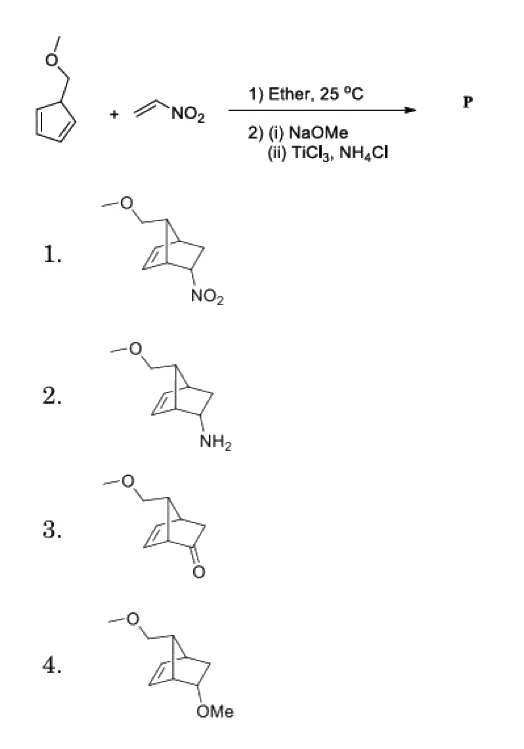
Identify the major product, P formed in the given reaction: 5-(methoxymethyl)cyclopenta-1,3-diene + nitroethene (CHX2=CH−NOX2), 1) ether, 25∘C; 2) (i) NaOMe, (ii) TiClX3, NHX4Cl→ P.
AStructure (1)
BStructure (2)
CStructure (3)
DStructure (4)
Show answer and explanation
Answer: C. Structure (3)
Nitroethene acts as a ketene equivalent: the Diels-Alder reaction gives the 7-(methoxymethyl)-5-nitronorbornene, whose nitronate (NaOMe) is converted to the ketone by the TiClX3 Nef reaction, giving the norbornenone (Corey's prostaglandin route). The tempting wrong option is the amine (2), since TiClX3 can reduce nitro groups, but on the nitronate it gives the carbonyl.
The arithmetic mean and median of the given data: 20.00, 20.20, 20.40, 20.60, 20.80, 21.20, 24.20, 24.60, respectively, are
A21.50 and 20.70
B21.50 and 20.60
C21.50 and 21.50
D20.60 and 20.80
Show answer and explanation
Answer: A. 21.50 and 20.70
The sum is 172.00, so the mean is 172.00/8=21.50; with eight values the median is the average of the 4th and 5th, (20.60+20.80)/2=20.70. Option 2 wrongly takes the 4th value alone as the median.
According to Hückel theory, the correct statement about the butadiene, is,
AExciting an electron from the HOMO to the LUMO will not change the π bond order.
BThe central C–C bond has a lower π-bond order than the terminal C–C bonds.
CIt is most likely to undergo electrophilic substitution at one of the two inner carbon atoms.
DThere are three π-energy levels and one non-bonding MO.
Show answer and explanation
Answer: B. The central C–C bond has a lower π-bond order than the terminal C–C bonds.
Hückel π bond orders in butadiene are 0.894 (terminal) and 0.447 (central), so the central bond has the lower π bond order. HOMO to LUMO excitation changes them (to 0.447 and 0.724), and there are four π levels (α±1.618β, α±0.618β) with no non-bonding MO.
The presence of 1940K makes living tissue appreciably radioactive. It may decay either by β emission or K capture. The resulting nuclei, respectively, are:
A1840Ar and 2040Ca
B2040Ca and 1840Ar
C1939K and 2040Ca
D1939K and 1840Ar
Show answer and explanation
Answer: B. 2040Ca and 1840Ar
β− emission converts a neutron to a proton (Z rises to 20, giving 40Ca), while K-electron capture converts a proton to a neutron (Z falls to 18, giving 40Ar); the mass number stays 40. Option 1 has the two reversed.
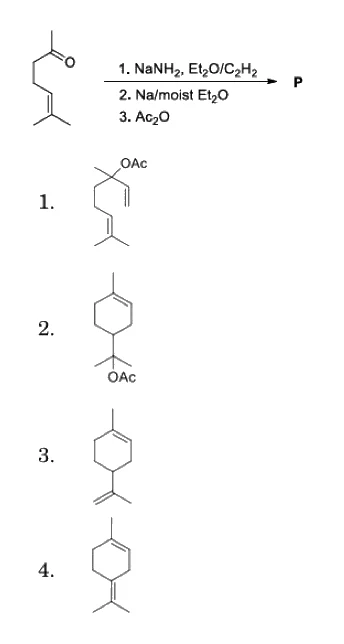
Which one of the following is the major product, P of the given reaction? 6-Methylhept-5-en-2-one, 1. NaNHX2, EtX2O/CX2HX2; 2. Na/moist EtX2O; 3. AcX2O→ P.
AStructure (1)
BStructure (2)
CStructure (3)
DStructure (4)
Show answer and explanation
Answer: A. Structure (1)
Sodium acetylide adds to the ketone to give the tertiary propargylic alcohol (dehydrolinalool), Na/moist ether reduces the terminal alkyne to the vinyl group (linalool), and AcX2O gives linalyl acetate, structure 1. The cyclised α-terpinyl acetate (2) is tempting but needs acid-catalysed cyclisation, which is not used here.
A proton chemical shift of δ=3.2 ppm corresponds to a frequency of 2400 Hz on a certain NMR instrument. The magnetic field strength of this instrument, in MHz, is
A750
B800
C600
D1000
Show answer and explanation
Answer: A. 750
δ(ppm)=Δν(Hz)/ν0(MHz), so ν0=2400/3.2=750 MHz. Option 2 (800) results from a slip in the division.
In pure rotational Raman spectroscopy, the selection rule ΔJ=0 for a linear rotor contributes to which one of the following?
ARayleigh radiation
BVibrational excitation
CStokes lines
DAnti-stokes lines
Show answer and explanation
Answer: A. Rayleigh radiation
For a linear rotor ΔJ=0,±2; ΔJ=0 means no change in rotational energy, so the scattered light is unshifted (Rayleigh line). ΔJ=+2 gives the Stokes lines and ΔJ=−2 the anti-Stokes lines.
Ziegler-Natta catalyst is the binary mixture of titanium chloride and aluminum alkyl (TiClX4/EtX3Al). It polymerizes propylene and gives predominantly isotactic isomer. The polymerization chain growth proceeds via:
AOxidative addition.
BReductive elimination.
COxidative coupling.
DMigratory insertion.
Show answer and explanation
Answer: D. Migratory insertion.
In the Cossee-Arlman mechanism the alkene coordinates at a vacant Ti site and the growing alkyl chain migrates onto it (1,2-migratory insertion), repeating without change in the metal oxidation state. Oxidative addition is the tempting wrong choice but no redox step is involved in propagation.
The ultimate source of reducing electrons generated in the photosystem-II (PS II), is:
AChlorophyll a
BChlorophyll b
COxygen Evolving Complex (OEC)
DHX2O
Show answer and explanation
Answer: D. HX2O
Water is oxidised at the MnX4CaOX5 cluster (2HX2OOX2+4HX++4eX−), and these electrons refill P680+; so water is the ultimate electron source. The OEC (option 3) is only the catalyst that passes the electrons on.
95 more questions from this paper are in the app
In the Tatva app you get the whole paper with the real clock and marking, every answer explained, your score, and an AI tutor for each mistake.