Tatva

CSIR NET Chemical Sciences

CSIR NET Dec 2025: questions with answers and explanations

10 of the 118 questions, with answers and explanations. The full paper is in the Tatva app. Answers follow the official final key.

Question 21Periodic trends
Among the following, the INCORRECT statement regarding ionization energy is
  1. AIt decreases as the size of the atom increases
  2. BIt increases with increase in nuclear charge
  3. CIt increases continuously from to across the second period
  4. DThe ionization energy is higher for electrons in orbitals with greater penetration
Show answer and explanation

Answer: C. It increases continuously from to across the second period

Ionization energy does not increase continuously from to because oxygen () has a lower first ionization energy than nitrogen () due to inter-electron repulsion in the doubly occupied orbital and the extra stability of nitrogen's half-filled subshell. Statement (C) is therefore incorrect. Statements (A), (B), and (D) are correct periodic trends, with (D) reflecting that penetrating orbitals experience greater effective nuclear charge than or orbitals.
Question 22Main group
The correct sequence of increasing bond length in the following species is
  1. A, , ,
  2. B, , ,
  3. C, , ,
  4. D, , ,
Show answer and explanation

Answer: A. , , ,

Bond length is inversely related to bond order: has a bond order of (), while has significant double-bond character due to resonance with fluoroperoxyl forms (). For the single-bonded species, () is shorter than () because the dianion experiences stronger electron-electron repulsion. Option B incorrectly places before the higher-bond-order .
Question 23Main group
The reaction NOT falling under the category of acid–base reaction is
  1. A
  2. B
  3. C
  4. D
Show answer and explanation

Answer: D.

In , platinum is oxidized from to while xenon is reduced from to , classifying it as a redox reaction rather than an acid–base process. Reactions (A), (B), and (C) represent Brønsted acid–base protonation, Lux–Flood/Lewis fluoride-ion transfer, and Lewis acid adduct formation, respectively. Option (B) is easily misidentified as redox, but it involves only transfer without any change in oxidation states.
The stretching frequency of phosphoryl compounds follows the order
  1. A
  2. B
  3. C
  4. D
Show answer and explanation

Answer: B.

More electronegative substituents withdraw electron density inductively from phosphorus, increasing the effective positive charge on and enhancing oxygen-to-phosphorus back-bonding, which strengthens the bond and raises . The substituent electronegativity follows , as -hybridized phenyl is more electron-withdrawing than -hybridized methyl (observed values are roughly , , , and , respectively). Option A incorrectly ranks above .
Question 25Group theory
The point groups of and , respectively, are
  1. A and
  2. B and
  3. C and
  4. D and
Show answer and explanation

Answer: C. and

adopts an eclipsed conformation due to the -bond between the two centers, giving a axis, perpendicular axes, and a plane for symmetry. In the standard idealized chelate geometry, possesses three mutually perpendicular axes, three mirror planes, and an inversion center, belonging to . Option D wrongly assumes a staggered geometry for the rhenium dimer.
Question 26Lanthanides and actinides
Consider the following statements regarding the extraction and separation of lanthanoids from Monazite

A. Monazite is primarily salt of Ln
B. Monazite contains Th along with Ln
C. ions are separated by using ion-exchange columns
D. ions are eluted from the column by using an aqueous acidic solution of

The option with all correct statements is
  1. AA, B, and D only
  2. BB, C, and D only
  3. CA, C, and D only
  4. DA, B, and C only
Show answer and explanation

Answer: D. A, B, and C only

Monazite is primarily an orthophosphate mineral of lanthanoids () typically rich in thorium, and the individual ions are efficiently separated using cation-exchange chromatography. Statement D is incorrect because is poorly soluble in acidic water; elution instead uses buffered aqueous solutions of its salts, such as ammonium EDTA, or hydroxyisobutyrate. Therefore, A, B, and C are the correct statements, which rules out options containing D.
Question 27Organometallics
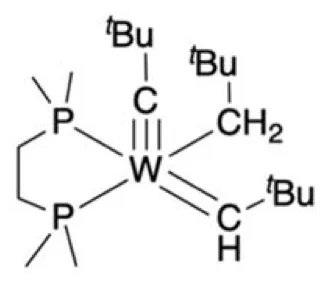
The correct option of bond lengths () of the metal-alkylidene and metal-alkylidyne, respectively, and the corresponding NMR chemical shifts () of the complex below

is
Question 27
  1. A1.78, 1.94 and 296, 256
  2. B1.94, 1.78 and 256, 296
  3. C1.94, 1.78 and 296, 256
  4. D1.78, 1.94 and 256, 296
Show answer and explanation

Answer: B. 1.94, 1.78 and 256, 296

A metal-carbon triple bond (alkylidyne) has a higher bond order and is shorter than a double bond (alkylidene), so is while is . In NMR spectroscopy, the strongly deshielded alkylidyne carbon resonates further downfield () than the alkylidene carbon (). Option C incorrectly inverts the relative chemical shifts, while Option A reverses the bond lengths.
Question 28Organometallics
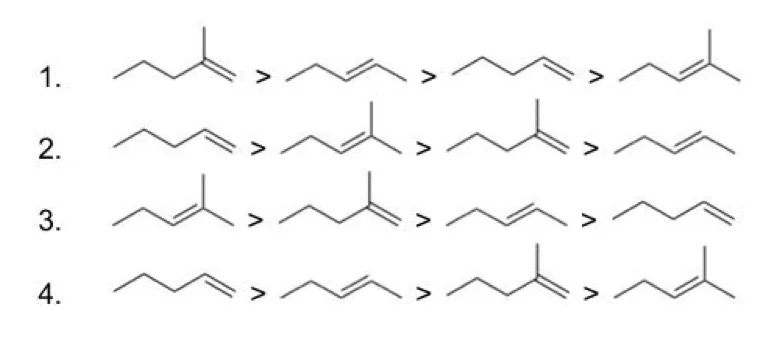
The relative reactivity of alkenes for the cobalt-catalyzed hydroformylation reaction follows the order
Question 28
  1. AOption 1
  2. BOption 2
  3. COption 3
  4. DOption 4
Show answer and explanation

Answer: D. Option 4

Hydroformylation rates with cobalt catalysts () are primarily governed by steric hindrance around the double bond during alkene coordination and migratory insertion. Linear terminal alkenes react fastest, followed by linear internal alkenes, then 1,1-disubstituted terminal alkenes, and finally more hindered trisubstituted alkenes. Option B is incorrect because it mistakenly ranks the hindered trisubstituted alkene ahead of less hindered disubstituted alkenes.
Question 29Organometallics
The option with the correct fragments that are isolobal with "S" atom

A.
B.
C.
D.

is
  1. AA, B, and C only
  2. BA, C, and D only
  3. CB, C, and D only
  4. DA, B, and D only
Show answer and explanation

Answer: B. A, C, and D only

A sulfur atom has 6 valence electrons and is two electrons short of an octet, making it isolobal with 16-electron organometallic fragments and 6-electron main group fragments. (), (), and () each require two electrons, so A, C, and D are isolobal with . In contrast, B fails because possesses 17 valence electrons (), making it isolobal with a one-electron acceptor like .
Question 30Main group
Consider the following statements about generation using Kipp's apparatus

A. The reagents used are and dil.
B. The reagents used are and conc.
C. can be prepared intermittently (on-demand)
D. Kipp's apparatus consists of three chambers

The option with the correct statements is
  1. AB, C and D only
  2. BA and D only
  3. CA, C and D only
  4. DB and C only
Show answer and explanation

Answer: C. A, C and D only

In Kipp's apparatus, is prepared on demand (intermittently) by reacting solid in the middle chamber with dilute from the upper reservoir, which consists of three interconnected chambers (A, C, and D are correct). Concentrated cannot be used because it is a strong oxidizing agent that oxidizes to elemental sulfur, making statement B incorrect. Thus, option B is incomplete because it omits C, and option A incorrectly includes B.

108 more questions from this paper are in the app

In the Tatva app you get the whole paper with the real clock and marking, every answer explained, your score, and an AI tutor for each mistake.

  • Organic30
  • Physical25
  • Inorganic21
  • General Aptitude20
  • Spectroscopy9
  • Analytical3

More CSIR NET Chemical Sciences papers