The HOMO (highest occupied molecular orbital) to LUMO (lowest unoccupied molecular orbital) electronic transition responsible for the observed colours of halogen molecules (gas) is
Aπ∗→σ∗
Bπ→π∗
Cσ→σ∗
Dπ→σ∗
Show answer and explanation
Answer: A. π∗→σ∗
Diatomic halogen molecules (X2) have 14 valence electrons with the ground-state configuration σs2σs∗2σp2πp4πp∗4σp∗0. The highest occupied molecular orbital (HOMO) is the antibonding π∗ orbital and the lowest unoccupied molecular orbital (LUMO) is the antibonding σ∗ orbital, making π∗→σ∗ the lowest-energy HOMO-to-LUMO transition that absorbs in the visible region. Option B is incorrect because the π∗ orbitals are completely filled and cannot serve as the LUMO.
In the hydrolysis of trans-[Co(en)X2Cl(A)]X+, if the leaving group is chloride, the formation of cis product is the least, when A is,
ANOX2X−
BNCSX−
CClX−
DOHX−
Show answer and explanation
Answer: A. NOX2X−
Strong π-acceptor ligands like NOX2X− stabilize a square pyramidal five-coordinate intermediate during dissociation, leading to complete retention of configuration (100% trans product, hence 0% cis). In contrast, π-donor ligands like OHX− (Option D) and ClX− (Option C) stabilize a trigonal bipyramidal intermediate, which promotes rearrangement and produces significant amounts of the cis isomer.
The expected number of 19F NMR spectral lines, including satellites, for [XeFX5]X− is [Abundance of 129Xe (I=1/2) = 26%]
Atwo
Btwenty one
Cthree
Done
Show answer and explanation
Answer: C. three
In pentagonal planar [XeFX5]X−, all five fluorine atoms are chemically and magnetically equivalent. Molecules containing non-magnetic xenon isotopes (I=0) produce a central singlet, while coupling with NMR-active 129Xe (I=1/2) splits the signal into a doublet (2I+1=2) appearing as satellites. This gives a total of 1+2=3 spectral lines; option D overlooks the satellite doublet from 129Xe coupling.
HX3X+ contains two valence electrons distributed over three protons in a two-electron three-center (2e-3c) bond. Constructive overlap of all three hydrogen 1s orbitals stabilizes an equilateral triangular geometry (D3h symmetry), resulting in an H−H−H bond angle of 60∘. The linear geometry (180∘, option A) is a higher-energy saddle point because it lacks the cyclic three-center orbital stabilization.
The number of bridging ligand(s) and metal-metal bond(s) present in the complex [RuX2(ηX5-Cp)X2(CO)X2(PhX2PCHX2PPhX2)] (obeys 18-electron rule), respectively, are
A0 and 1
B2 and 1
C3 and 1
D1 and 2
Show answer and explanation
Answer: C. 3 and 1
Total valence electron count is (2×8)+(2×5)+(2×2)+4=34, requiring (36−34)/2=1Ru−Ru bond to satisfy the 18-electron rule. Structurally, the dppm ligand bridges the two metal centers (μ-dppm) along with both carbonyl ligands (2μ-CO), totaling 3 bridging ligands. Option B is incorrect because it overlooks the bridging nature of the bidentate diphosphine.
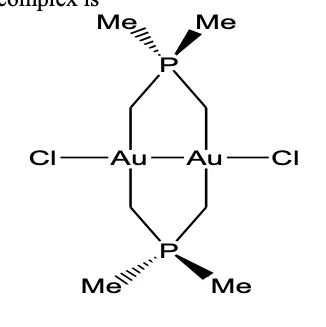
The oxidation state of gold in the following complex is
A0
B1
C2
D3
Show answer and explanation
Answer: C. 2
Each bridging ylide ligand, [MeX2P(CHX2)X2]X−, acts as a formal monoanion, donating two electrons with a −1 charge per ligand. With two bridging ylides (−2) and two terminal chloride ligands (−2), the neutral dinuclear core requires 2×OS(Au)−4=0, giving an oxidation state of +2 for each gold atom with an Au(II)−Au(II) single bond. Option B incorrectly treats the bridging ylide as a neutral diphosphine.
The rate of alkene coordination to [PtClX4]X2− is highest for
Anorbornene
Bethylene
Ccyclohexene
D1-butene
Show answer and explanation
Answer: A. norbornene
Norbornene has severe ring strain in its bicyclic ground state. Coordination to Pt(II) shifts hybridization from sp2 toward sp3, which relieves considerable angular and torsional strain, driving a substantially faster rate of binding. Although ethylene (B) is sterically unhindered, it lacks the ground-state strain relief that accelerates the coordination of norbornene.
The nephelauxetic parameter is defined as β=B/B0, where a value closer to 1 indicates less covalency and minimal expansion of the metal d-electron cloud. Being the most electronegative and least polarizable ligand among the choices, FX− causes the smallest nephelauxetic effect (least reduction in B), leading to the highest β value. Highly covalent ligands like CNX− (option C) cause strong d-electron delocalization, resulting in the lowest β instead.
The X2X222EXgX4X224AX2g transition in the electronic spectrum of [Cr(NHX3)X6]X3+ occurs nearly at
A650 nm
B450 nm
C350 nm
D200 nm
Show answer and explanation
Answer: A. 650 nm
In an octahedral d3 complex like [Cr(NHX3)X6]X3+, the spin-forbidden X2X222EXgX4X224AX2g transition arises from within the t2g3 configuration and requires less energy than the spin-allowed transitions. It appears as a weak band near 15000 cm−1, which corresponds to λ≈107/15000≈667 nm≈650 nm. Option B (450 nm) fails because it corresponds to the higher-energy spin-allowed X4X224TX2gX4X224AX2g transition (Δo).
In the catalytic hydration of COX2 by carbonic anhydrase, COX2 first interacts with
AOH group of the active site of the enzyme and then with zinc
BHX2O of the active site of the enzyme and then with zinc
Czinc of the active site of the enzyme and then with OH group
Dzinc of the active site of the enzyme and then with HX2O
Show answer and explanation
Answer: A. OH group of the active site of the enzyme and then with zinc
In carbonic anhydrase, ZnX2+ lowers the pKa of coordinated water to form a nucleophilic Zn−OHX− species at physiological pH. The carbon atom of COX2 is first attacked nucleophilically by this coordinated OHX− group, and one of the resulting oxygen atoms then coordinates to the zinc center to form a bicarbonate complex. Option C is incorrect because COX2 does not directly bind to zinc prior to nucleophilic attack by hydroxide.
134 more questions from this paper are in the app
In the Tatva app you get the whole paper with the real clock and marking, every answer explained, your score, and an AI tutor for each mistake.