UP PGT Chemistry 2021: questions with answers and explanations
10 of the 118 questions, with answers and explanations. The full paper is in the Tatva app. Answers checked against a standard solved-papers book and by Tatva.
In 2,6-dihydroxybenzoic acid the carboxylate is held by two intramolecular hydrogen bonds from the flanking OH groups, strongly stabilising the conjugate base. Salicylic acid (B) has only one such hydrogen bond and is weaker.
In the following compounds: (i) phenol, (ii) p-cresol (4-methylphenol), (iii) m-nitrophenol, (iv) p-nitrophenol, the order of acidity is
AIII > IV > I > II
BI > IV > III > II
CII > I > III > IV
DIV > III > I > II
Show answer and explanation
Answer: D. IV > III > I > II
A para-nitro group stabilises phenoxide by both –M and –I, a meta-nitro group only by –I, while a para-methyl group destabilises it by +I and hyperconjugation; hence IV > III > I > II. Option A wrongly puts meta-nitro above para-nitro.
In which of the following is d-orbital resonance possible?
ACFX3X−
BCClX3X−
CCHX3X−
DCHFX2X−
Show answer and explanation
Answer: B. CClX3X−
Chlorine, a third-period element, has vacant 3d orbitals that can accept the carbanion's lone pair (pπ–dπ back bonding), stabilising CClX3X−. Fluorine in CFX3X− (A) has no accessible d orbitals.
Phorone (2,6-dimethylhepta-2,5-dien-4-one) forms when three acetone molecules condense with loss of two water molecules under dry HCl. Option B is mesityl oxide, the product from only two acetone molecules.
Answer: B. (CHX3)X2C(OH)CHX2CHX2C(OH)(CHX3)X2
Hydroxyl radicals from FeX2++HX2OX2 abstract a methyl hydrogen of t-butanol, and two of the resulting C˙HX2C(CHX3)X2OH radicals couple to give 2,5-dimethylhexane-2,5-diol. Option D has an extra C=C bond that radical coupling does not create.
Which one is not a nucleophilic reagent in the following?
ACHX3X−
BNHX2X−
C:CHX2
DR−O¨−R
Show answer and explanation
Answer: C. :CHX2
Methylene carbene has only six valence electrons on carbon and behaves as an electron-seeking electrophile. An ether (D) is a weak but genuine nucleophile through its oxygen lone pairs.
Which carbanion is most stable among those given below?
AR−C≡CX−
BRX2C=CX−−R
CRX3C−CHX2X−
DCHX3X−
Show answer and explanation
Answer: A. R−C≡CX−
The acetylide lone pair sits in an sp orbital with 50% s-character, holding the negative charge closest to the nucleus. The vinyl anion (B) is sp² and less stabilised.
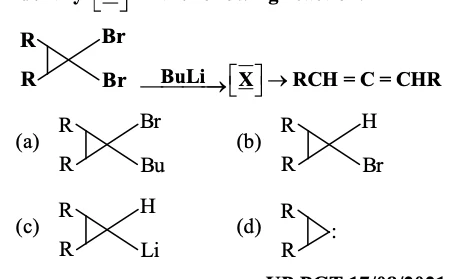
Identify X in the following reaction: 1,1-dibromo-2,3-dialkylcyclopropane BuLi [X] →RCH=C=CHR
AStructure (A)
BStructure (B)
CStructure (C)
DStructure (D)
Show answer and explanation
Answer: D. Structure (D)
In the Doering-LaFlamme allene synthesis, BuLi exchanges one Br to give a lithium carbenoid that loses LiBr to form the cyclopropylidene carbene (structure D), which ring-opens to the allene RCH=C=CHR. The H/Li species (C) has no leaving group and cannot give the carbene.
Which intermediate forms triptycene on reaction with anthracene?
ABenzyne
BCarbene
CNitrene
DCarbocation
Show answer and explanation
Answer: A. Benzyne
Benzyne acts as a dienophile and adds across the 9,10-positions of anthracene in a [4+2] cycloaddition, giving the bridged triptycene skeleton. A carbene (B) would add to a single double bond to give a cyclopropane, not this bicyclic adduct.
RX2CH−OH+SOClX2EtherΔRX2CH−Cl+SOX2+HCl. This reaction can be explained by
ASN1 mechanism
BSN2 mechanism
CE2 mechanism
DSNi mechanism
Show answer and explanation
Answer: D. SNi mechanism
The alcohol forms an alkyl chlorosulfite, which collapses through a tight ion pair so that chloride is delivered from the same face as the leaving group, with retention: internal nucleophilic substitution (SNi). SN2 would apply only if pyridine were added, giving inversion.
108 more questions from this paper are in the app
In the Tatva app you get the whole paper with the real clock and marking, every answer explained, your score, and an AI tutor for each mistake.