UP PGT Chemistry 2010: questions with answers and explanations
10 of the 64 questions, with answers and explanations. The full paper is in the Tatva app. Answers checked against a standard solved-papers book and by Tatva.
Three fluorines exert the strongest –I effect, stabilising the trifluoroacetate anion most. Trichloroacetic acid (C) is strong too, but chlorine is less electronegative than fluorine.
Which of the following are aromatic? X = pyridine, Y = pyrrole, Z = cyclohexadiene
AX, Z
BY, Z
CZ
DX, Y
Show answer and explanation
Answer: D. X, Y
Pyridine and pyrrole are planar, fully conjugated rings with 6 π electrons, satisfying Hückel's rule. Cyclohexadiene has an sp³ ring carbon that breaks conjugation, so any option containing Z is wrong.
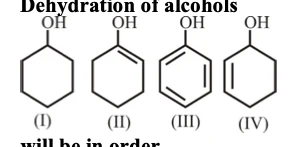
Dehydration of the alcohols I. cyclohexanol, II. cyclohex-1-en-1-ol (OH on the double-bond carbon), III. phenol, IV. cyclohex-2-en-1-ol (allylic OH) will be in the order
AI < II < III < IV
BI > II > III > IV
CIII < II < I < IV
DII < III < IV < I
Show answer and explanation
Answer: C. III < II < I < IV
Ease of dehydration follows the stability of the carbocation formed: the allylic cation from cyclohexenol IV forms most easily, then the secondary cation from cyclohexanol I, while vinylic (II) and phenyl (III) cations are very unstable. This gives III < II < I < IV; 'I < II < III < IV' wrongly treats phenol as the easiest.
Ethyl alcohol is obtained by reduction of acetaldehyde with the reagent
AHX2 + Ni
BZn/Hg + conc. HCl
CBa(OH)X2
DMg–Hg/HX2O
Show answer and explanation
Answer: A. HX2 + Ni
Catalytic hydrogenation over nickel reduces the C=O group of acetaldehyde to the primary alcohol ethanol. Clemmensen conditions (B) would reduce the carbonyl all the way to ethane.
Ammonia has a lone pair on nitrogen that it donates to electron-poor centres. BFX3 (B), SOX3 and FeClX3 are electron-pair acceptors, i.e. electrophiles.
In the following reaction BrCHX2CHX2CHX2CHX2Br+KOH(alcoholic)P, P is
A1,2-butadiene
B1,3-butadiene
CButane
DIsobutylene
Show answer and explanation
Answer: B. 1,3-butadiene
Alcoholic KOH removes HBr from each end of 1,4-dibromobutane, giving CHX2=CH−CH=CHX2 (1,3-butadiene). The cumulated 1,2-diene would need both eliminations around one carbon, which this substrate cannot give.
Which of the following is not formed by the reaction of ClX2 with CHX4 in presence of sunlight?
ACHX3CHX2CHX3
BCHX3−CHX3
CCHX3Cl
DCHClX3
Show answer and explanation
Answer: A. CHX3CHX2CHX3
Chlorination gives CHX3Cl through CHClX3 by successive substitution, and termination by two methyl radicals gives ethane. Only one-carbon radicals are present, so a three-carbon product like propane cannot form.
Which of the following reagents is used to convert >CHOH group to >C=O group?
APt/HX2
BBrX2/NaOH
CCu/300°C
DZnClX2
Show answer and explanation
Answer: C. Cu/300°C
Passing a secondary alcohol over hot copper at about 300 °C removes HX2 and gives the ketone. Pt/HX2 reduces rather than oxidises, and ZnClX2 is the Lucas reagent.
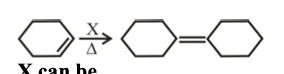
Cyclohexene on heating with X gives cyclohexylidenecyclohexane (two cyclohexane rings joined by a C=C double bond), as shown. X can be
Aconc. HX2SOX4
Balcoholic KOH
CEtX3N
Dt-BuOK
Show answer and explanation
Answer: A. conc. HX2SOX4
Concentrated H2SO4 protonates cyclohexene to the cyclohexyl cation, which adds to a second cyclohexene; hydride shifts and loss of H+ give the tetrasubstituted cyclohexylidenecyclohexane. Bases such as 'alcoholic KOH' or t-BuOK cannot dimerise an alkene.
When Grignard reagent (RMgX) reacts with a ketone as Ketone + RMgX → X HX2O Y, Y is
Aan acid
Bprimary alcohol
Ctertiary alcohol
Dsecondary alcohol
Show answer and explanation
Answer: C. tertiary alcohol
R adds to the carbonyl carbon, which already carries two carbon groups, so hydrolysis gives a tertiary alcohol. Aldehydes give secondary alcohols and formaldehyde gives primary ones.
54 more questions from this paper are in the app
In the Tatva app you get the whole paper with the real clock and marking, every answer explained, your score, and an AI tutor for each mistake.