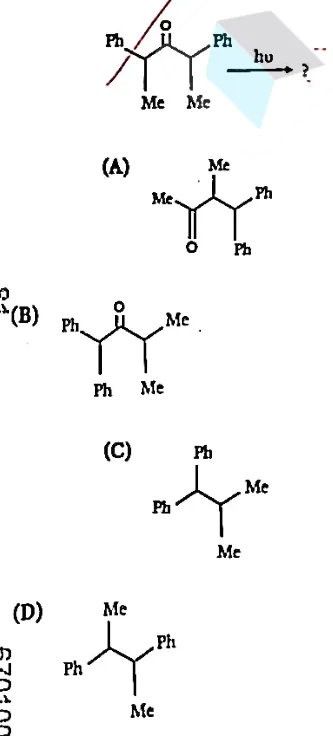
Predict the major product obtained in the following reaction.
[IMAGE]
AStructure (A)
BStructure (B)
CStructure (C)
DStructure (D)
Show answer and explanation
Answer: D. Structure (D)
Photolysis of 2,4-diphenylpentan-3-one undergoes Norrish Type I cleavage (α-cleavage) to generate a stable benzylic radical, PhCHX∙Me, and an acyl radical. Rapid decarbonylation (extrusion of CO) from the acyl radical generates a second benzylic radical, which couples to yield 2,3-diphenylbutane as the major product shown in D. Option C incorrectly places both phenyl rings on the same carbon, while options A and B fail to undergo decarbonylation.
Match List-I with List-II: List-I: (a) Interstitial carbides (b) Salt-like carbides (c) Cu and Ag acetylides (d) Covalent carbides
List-II: (I) Very hard, refractory materials (II) Explosive and sensitive to shock (III) Show metallic conductivity (IV) React with water to produce hydrocarbons
Choose the correct answer from the codes given below-
Aa-III, b-IV, c-I, d-II
Ba-III, b-IV, c-II, d-I
Ca-I, b-II, c-III, d-IV
Da-IV, b-III, c-II, d-I
Show answer and explanation
Answer: B. a-III, b-IV, c-II, d-I
Interstitial carbides of transition metals retain metallic bonding, exhibiting metallic conductivity (a-III), while ionic or salt-like carbides readily hydrolyze with water to evolve hydrocarbons like CHX4 or CX2HX2 (b-IV). Transition-metal acetylides such as CuX2CX2 and AgX2CX2 are notoriously shock-sensitive and explosive (c-II), and covalent network carbides like SiC are extremely hard, refractory solids (d-I). Option A fails by incorrectly swapping the properties of acetylides and covalent carbides.
Which statement correctly contrasts acetaldehyde decomposition and anthracene dimerization?
AAcetaldehyde decomposition is reversible, anthracene dimerization is not
BAnthracene dimerization shows quantum yields >1, while acetaldehyde decomposition does not
CBoth are unimolecular photoreactions with similar kinetics
DAcetaldehyde decomposition is chain-initiated, while anthracene dimerization is bimolecular
Show answer and explanation
Answer: D. Acetaldehyde decomposition is chain-initiated, while anthracene dimerization is bimolecular
Photochemical decomposition of acetaldehyde (CH3CHO) involves a free-radical chain reaction initiated by light-induced homolysis, yielding quantum efficiencies often exceeding unity at higher temperatures. In contrast, the photodimerization of anthracene proceeds via a bimolecular encounter between an electronically excited singlet anthracene molecule and a ground-state molecule, having a maximum theoretical quantum yield of 0.5. Option B fails because it inverts the quantum yields.
The Jahn-Teller distortion is most significant for which electronic configuration in an octahedral complex?
Ad10
Bd9
Cd3
Dd5 (high spin)
Show answer and explanation
Answer: B. d9
Jahn-Teller distortion is strongest when the degenerate eg orbitals, which point directly at the ligands, are unevenly occupied. A d9 octahedral configuration has the electronic state t2g6eg3, resulting in an asymmetric eg filling that causes substantial geometric distortion (typically tetragonal elongation). By contrast, options A (t2g6eg4), C (t2g3), and D (t2g3eg2) possess symmetrically filled or half-filled orbital sets and show no Jahn-Teller distortion.
Fick's first law of diffusion states that the molar flux due to mass transfer is directly proportional to the concentration gradient, expressed as JM=−Ddxdc, where D is the diffusion coefficient. Option B describes heat conduction rather than mass transfer, relating heat flux to a temperature gradient via q=−kdxdT.
XeF4 has four bonding pairs and two lone pairs on xenon (sp3d2 hybridization), resulting in a square planar geometry with the lone pairs occupying trans axial positions. Its symmetry elements include a principal C4 axis, four perpendicular C2 axes, a horizontal mirror plane σh, and an inversion center i, which together define the D4h point group. Option C (C4v) is incorrect because the presence of σh upgrades the symmetry to D4h.
Using Stirling's approximation, the most probable distribution of particles among energy states is derived by:
AApplying the principle of equal a priori probabilities
BMinimizing free energy at constant temperature & volume
CEquating degeneracy factors across states
DMaximizing entropy subject to energy and particle constraints
Show answer and explanation
Answer: D. Maximizing entropy subject to energy and particle constraints
In statistical thermodynamics, the thermodynamic probability W relates directly to entropy through Boltzmann's relation S=klnW. The most probable distribution corresponds to maximizing lnW (and thus entropy S) using Stirling's approximation (lnN!≈NlnN−N) under the constraints of fixed total particle number ∑Ni=N and constant total energy ∑Niϵi=E via Lagrange multipliers. Option B applies to equilibrium under canonical conditions rather than the microcanonical derivation using particle and energy constraints.
Crystallography involves the study of internal structure and physical properties of the crystals. There are three fundamental laws governing crystal systems. List-I and List- II contain the names of fundamental laws and statements, respectively. List-I: (a) Law of symmetry (b) Hauy's Law (c) Steno's Law List-II: (I) It is possible to choose along three coordinate axes unit distances (represented by a, b, c) such that ratio of these three intercepts of any plane of the crystal is given by ma:nb:pc, where m,n and p are either integral whole numbers including infinity or fractions of the whole numbers (II) All crystals of the same substance always have the same elements of symmetry (III) The angle of intersection of any two corresponding faces is always same for any crystal of the same substance Choose the correct answer from the codes given below-
Aa-I, b-II, c-III
Ba-III, b-II, c-I
Ca-II, b-I, c-III
Da-II, b-III, c-I
Show answer and explanation
Answer: C. a-II, b-I, c-III
The Law of Symmetry states that crystals of the same substance possess identical elements of symmetry (a-II). Haüy's law of rational indices defines plane intercepts as integral multiples of axial lengths ma:nb:pc (b-I), whereas Steno's law dictates the constancy of interfacial angles between corresponding crystal faces (c-III). This correctly establishes the mapping in Option C; Option D incorrectly swaps Haüy's and Steno's laws.
Which of the following statements correctly distinguishes Einstein's and Debye's models?
AEinstein predicts CV∝T3 at low temperatures, Debye predicts exponential decay.
BEinstein assumes all atoms vibrate with the same frequency; Debye assumes a spectrum of frequencies.
CDebye assumes anharmonic oscillations, Einstein assumes harmonic oscillations.
DBoth predict identical results at all temperatures.
Show answer and explanation
Answer: B. Einstein assumes all atoms vibrate with the same frequency; Debye assumes a spectrum of frequencies.
Einstein's model treats a solid as independent harmonic oscillators, each vibrating at the same characteristic frequency νE. In contrast, Debye's model accounts for collective acoustic modes, assuming a continuous spectrum of vibrational frequencies up to a maximum cutoff νD. Option A is incorrect because it reverses their low-temperature limits: Debye predicts CV∝T3, whereas Einstein predicts an exponential decay.
Why is Au(I), rather than Au(III), preferred in antirheumatic drugs?
AAu(I) is more stable in aqueous biological conditions and prefers sulphur coordination
BAu(I) forms octahedral complexes
CAu(I) is harder acid
DAu(I) is more oxidizing
Show answer and explanation
Answer: A. Au(I) is more stable in aqueous biological conditions and prefers sulphur coordination
According to HSAB theory, Au(I) is a soft Lewis acid with high affinity for soft sulfur donors, forming stable linear complexes with biological thiols like glutathione and albumin. In contrast, Au(III) is a strong oxidizing agent that is cytotoxic and rapidly reduced under physiological conditions. Option D fails because Au(III) is far more oxidizing than Au(I), while Option C fails because Au(I) is softer, not harder.
87 more questions from this paper are in the app
In the Tatva app you get the whole paper with the real clock and marking, every answer explained, your score, and an AI tutor for each mistake.