Solutions can form between any phases: alloys (solid in solid), sugar in water (solid in liquid) and dissolved gases such as CO2 in water (gas in liquid). So all the listed pairs can give homogeneous solutions.
Deviation from Markownikoff's rule occurs in presence of
AZinc
BPeroxides
CHg-Zn/HCl
DAll
Show answer and explanation
Answer: B. Peroxides
Organic peroxides start a free-radical chain for HBr addition, giving the anti-Markownikoff product (Kharasch effect). Zn and Zn-Hg/HCl are reducing agents with no such role.
Transition elements have their differentiating electron entering an (n-1)d subshell, so they form the d-block. f-block elements are the inner transition elements.
HCOOH contains an aldehyde-like H-C=O unit and is oxidised to CO2, so it reduces Tollen's reagent (silver mirror), HgCl2 (to Hg2Cl2/Hg) and KMnO4 (decolourised).
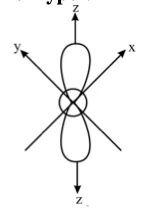
Which one of the following orbitals has the shape of baby-soother type (as shown in the figure)?
Adz2
Bdx2−y2
Cdxz
Ddxy
Show answer and explanation
Answer: A. dz2
The dz2 orbital has two lobes along the z-axis with a doughnut-shaped ring around the middle, which looks like a baby soother. dx2−y2 and dxy are tempting but both are four-leaf clover shapes.
Benzene vapour mixed with air when passed over VX2OX5 catalyst at 775 K gives
AGlyoxal
BOxalic acid
CMaleic anhydride
DFumaric acid
Show answer and explanation
Answer: C. Maleic anhydride
Vapour-phase air oxidation over V2O5 breaks the ring and gives maleic anhydride (plus CO2 and H2O); this is its industrial route. Fumaric acid is the trans isomer and cannot form a cyclic anhydride.
Isopropyl alcohol is heated at 300°C with copper catalyst to form
Aacetone
Bdimethyl ether
Cacetaldehyde
Dethane
Show answer and explanation
Answer: A. acetone
Hot copper dehydrogenates alcohols: a secondary alcohol such as propan-2-ol loses H2 to give the ketone, acetone. Acetaldehyde would come from ethanol, a primary alcohol.
Which of the following is an optically active compound?
An-Propanol
Bn-Butanol
C2-Chlorobutane
D4-Hydroxyheptane
Show answer and explanation
Answer: C. 2-Chlorobutane
C-2 of CHX3CHX2CHClCHX3 carries H, Cl, methyl and ethyl, four different groups, so it is chiral. In 4-heptanol the carbinol carbon holds two identical propyl groups, so it is achiral despite looking similar.
The alkene which on ozonolysis yields acetone only is:
ACHX2=CHX2
BCHX3−CH=CH−CHX3
C(CHX3)X2C=C(CHX3)X2
DCHX3−CH=CHX2
Show answer and explanation
Answer: C. (CHX3)X2C=C(CHX3)X2
Each half of 2,3-dimethylbut-2-ene is (CHX3)X2C=, so cleavage gives two molecules of acetone. The other alkenes give formaldehyde or acetaldehyde instead.
Lucas reagent is anhydrous zinc chloride dissolved in concentrated HCl; it distinguishes 1°, 2° and 3° alcohols by how fast turbidity appears. Dilute HCl is too weak a chloride source for the test.
46 more questions from this paper are in the app
In the Tatva app you get the whole paper with the real clock and marking, every answer explained, your score, and an AI tutor for each mistake.